Looking is never neutral: Ramzi Mallat in the Arab Hall

Words By Allegra Salvadori | Photography by Jaron James

May 4, 2026

As part of Leighton House Centenary Programme, Ramzi Mallat presents Atlas of An Entangled Gaze within the Arab Hall, a site where histories, architectures, and imaginaries converge. We spoke with the artist about gaze, memory, and the ways in which an installation can reorganise space.

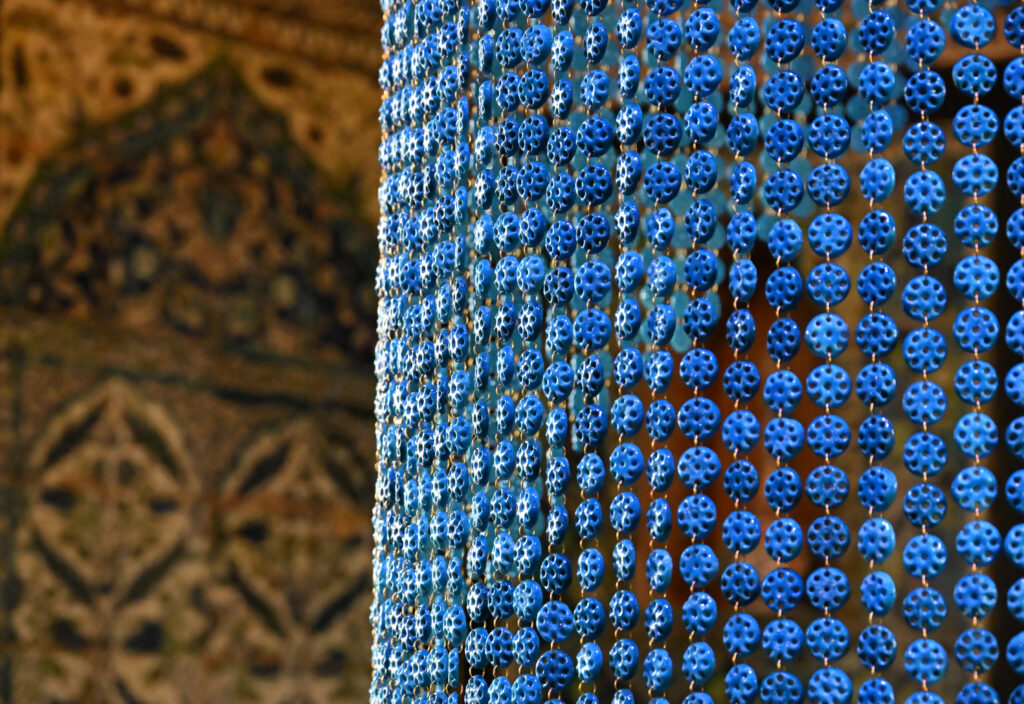
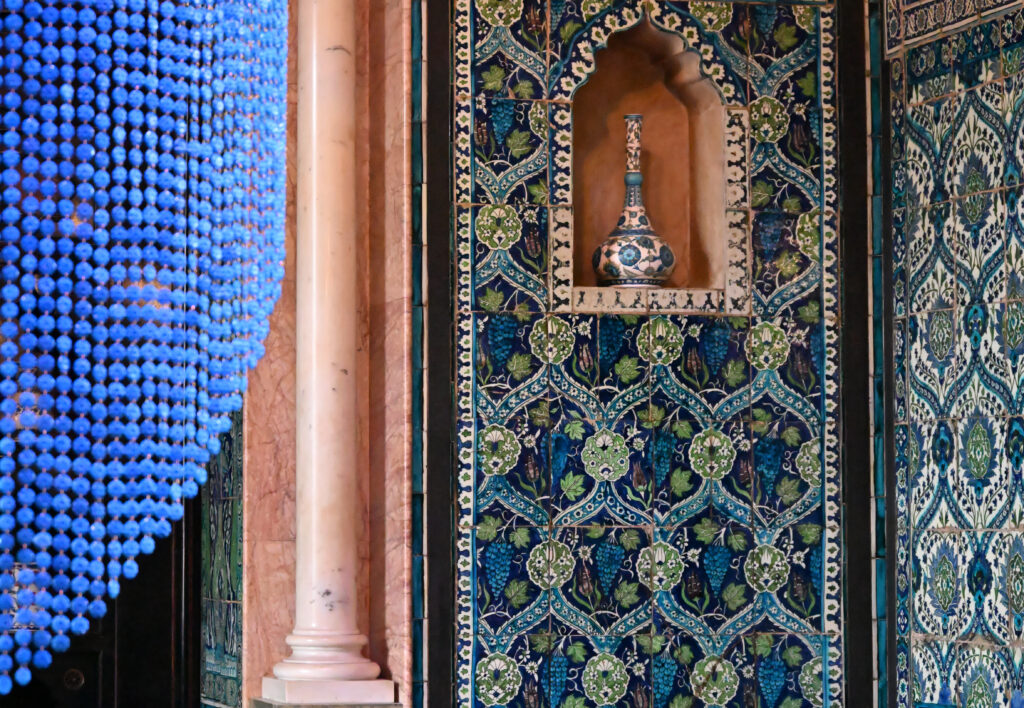
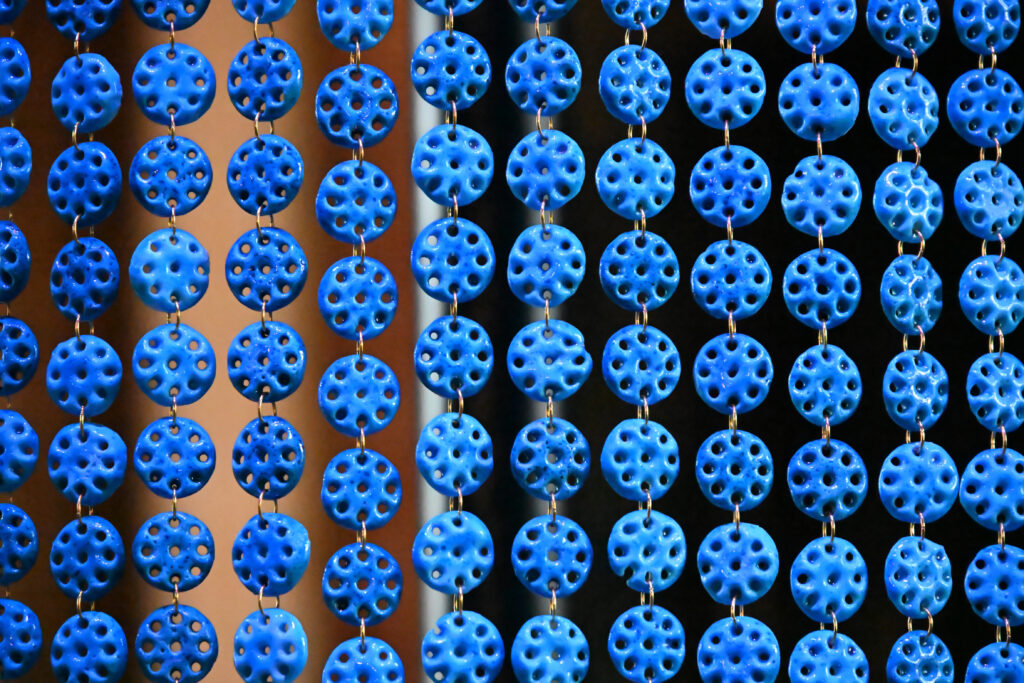
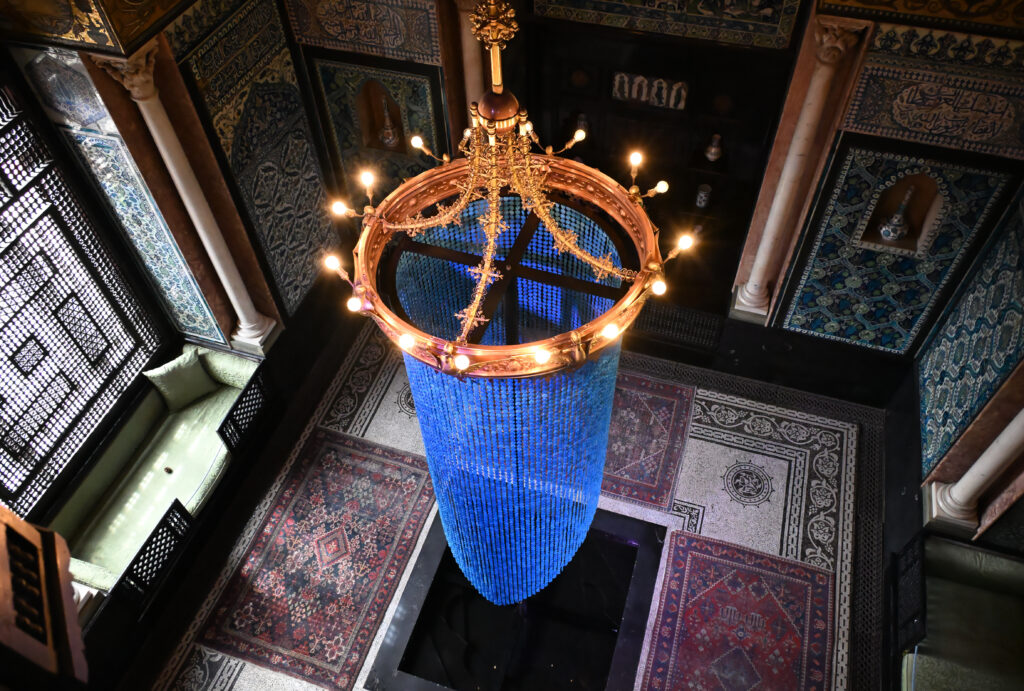
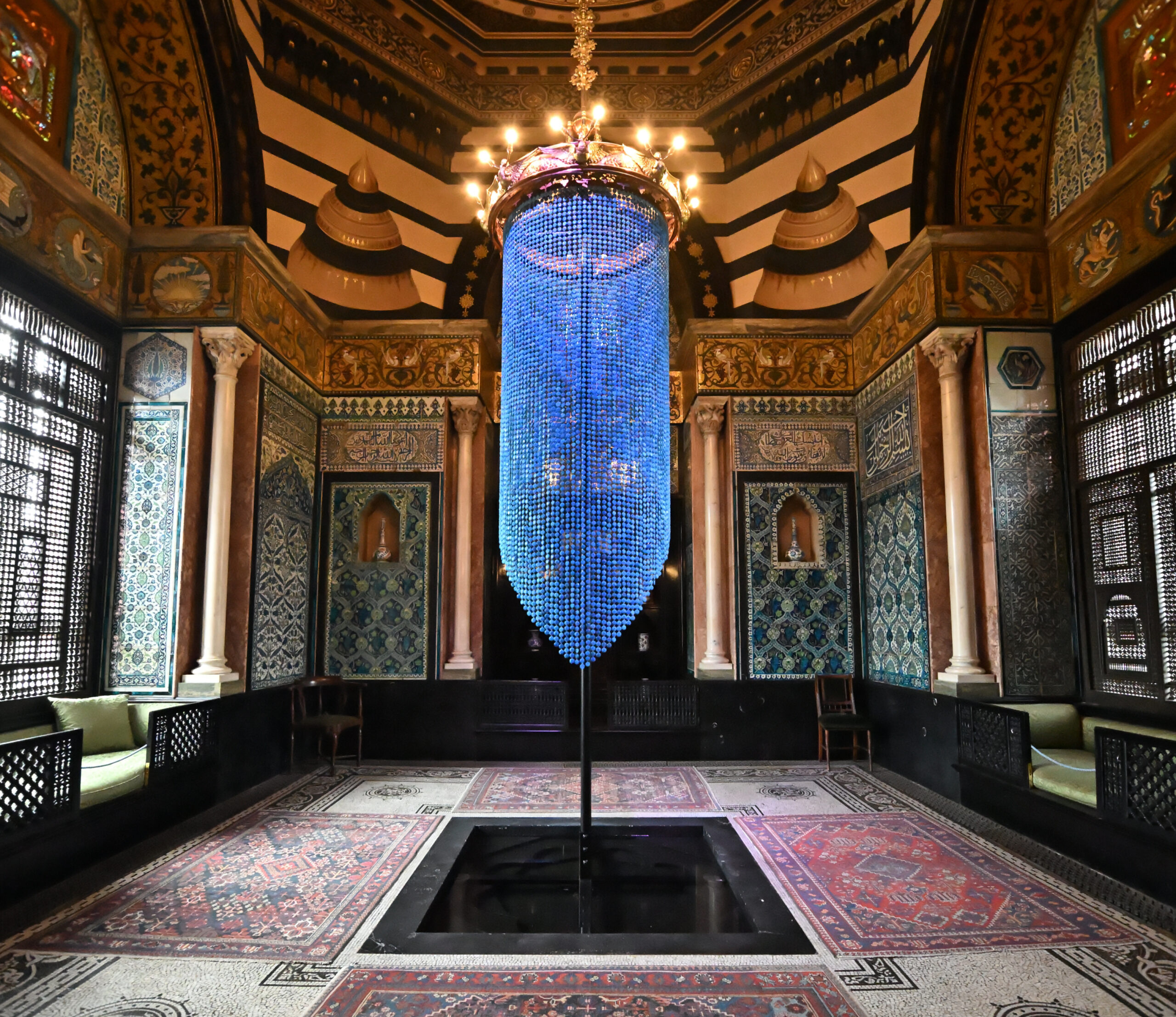
Ramzi Mallat Atlas of an Entangled Gaze 2026. Ceramic and metal 400 x 100 x 100 cm. Exhibited at Leighton House © Ramzi Mallat. Image courtesy of the artist 6

You describe the work as a “threshold between histories.” I’m curious whether you think of the threshold as something one crosses, or something one inhabits, like a permanent state of in-betweenness?

For me, the threshold is not a passage, it’s a condition, a sense of liminality that is not abstract but viscerally experienced. I believe that histories don’t resolve, they overlap, collide, and bleed into one another, so the idea of a delineated crossing feels very linear, almost too neat. What I’m interested in is suspension, being held within numerous temporalities and among narratives that refuse to settle. The work doesn’t invite the viewer to reach any certain conclusion, it asks to dwell within that tension, where these multiple narratives coexist without a sense of hierarchy. After all, meaning becomes porous when contradiction is the only stable ground.

The gaze, in this installation, is multiplied and suspended above the viewer. Does this inversion, being looked at rather than looking, introduce a form of vulnerability, or a redistribution of power?

There is something so primal in our understanding of the gaze, and it all stems back to the predator and prey relationship, where the one looking is in a position of power and the one being looked at is vulnerable.

In this installation, the gaze is no longer singular, no longer inscribed in this binary, but dispersed and atmospheric. As such, the work destabilizes the boundary between observer and observed, therefore implicating the viewer: you’re not just being looked at, but instead engaged in a wider sphere of seeing. And in that sense, I am interested in flipping the colonial gaze back in on itself, where there is no stratified authority, nor a single vantage point, but an imbued sense of exposure and precarity.

The evil eye is traditionally protective, yet your installation feels almost omniscient, even watchful. At what point does protection shift into a condition closer to surveillance?

While it is true that evil eye talismans have been traditionally used for protective purposes, the evil eye belief itself is ambivalent: both protective and malevolent at the same time. At its core, it is a symbol of awareness, of being seen and looking back, an unspoken social contract that underlines uncertainty, vulnerability, and protection. I like to believe it is a material representation of an inherent fear of the ‘other’, an object that transcribes both an immaterial belief and its material consequences. Through the repetitive use of the charms in the work, I wanted to frame a collective gaze, one that hints at visibility, panopticism, and fragility. And I believe this has direct relevance for audiences today, especially in a world mired with anxieties regarding artificial intelligence and the automation of surveillance and war. With this commission, I am interested in highlighting the perpetual fear and anxiety we all have in constantly being watched while unpacking its reverberations across temporal registers.

Ramzi Mallat Atlas of an Entangled Gaze 2026. Ceramic and metal 400 x 100 x 100 cm. Exhibited at Leighton House © Ramzi Mallat. Image courtesy of the artist 8

You are intervening within the Arab Hall, a space shaped by a 19th century European imagination of the “Orient.” How do you position your work in relation to that gaze: are you correcting it, inhabiting it, or deliberately complicating it?

The Arab Hall is a historic interior, but it is also a contentious space. It’s a hybridized and layered constructed vision that was built in the nineteenth century as an interpretation of the ‘Orient’ shaped by Frederic Leighton’s travels, collecting, and fascination. As such, it is a space of admiration but also displacement, extraction, and appropriation. I wanted to grapple with this Victorian and Orientalist lens that dominates the space while also framing this commission in a counter-colonial framework. But more importantly, I wanted to give a space that is constantly being gazed at the agency to look back. Hovering in the center of the room like a veil or canopy of watchful eyes, Atlas of An Entangled Gaze is therefore both a native and foreign presence in the space. It doesn’t aim to resolve these tensions, nor does it diffuse them, it instead holds and heightens them. The installation merges the ancient, the contested, and the contemporary, becoming a site where viewers are invited to reexamine the Arab Hall through new eyes. In that sense, I’m interested in nurturing a dialogue between contentious histories and living heritage by placing an artwork which inhabits and unsettles the space’s inherited narratives.

Kamilah Ahmed Ramzi Mallat Soudade Kaadan and Soraya Syed at Leighton House ©RBKC. Image Jaron James
Kamilah Ahmed, Ramzi Mallat, Soudade Kaadan and Soraya Syed at Leighton House ©RBKC. Image Jaron James

There is a strong architectural logic to the piece, particularly in the way the canopy aligns with the dome and echoes the mashrabiya. Do you approach this work as an object, or as a system that reorganises the space itself?

The work behaves more like an intervention, a filter or a membrane that intercepts light, redirects vision, and alters spatial perception. It reorients the body in relation to the architecture, and disrupts the decorative symmetry of the space, enabling a passive space to confront the viewer as they enter. In that sense, Atlas of An Entangled Gaze doesn’t just occupy the space, it rewrites the conditions under which it is experienced.

Repetition plays a central role: thousands of ceramic “eyes” forming a collective field. Is this accumulation a gesture of protection, or does it also speak to saturation, even excess, in how we process images today?

I see repetition as an act of meditation, and I’ve noticed it as a recurring theme in my practice. However, in this commission’s context, this repetition gestures towards a rupture exacerbated by a sensorial overload. By pushing the motif to this monumental scale, the installation challenges the phantasmagorical essence of the Arab Hall by imposing a saturated presence that redirects the viewer’s gaze to the center of the space. While this does hint at a kind of excess, it also shifts the power dynamics: I’m not looking to protect the Arab Hall through this commission, but to instead charge it with an unparalleled agency to reclaim its presence in such a domestic setting as Leighton House.

Ramzi Mallat Atlas of an Entangled Gaze 2026. Ceramic and metal 400 x 100 x 100 cm. Exhibited at Leighton House © Ramzi Mallat. Image courtesy of the artist 9

Your practice often draws from Levantine symbols, yet avoids fixing them in time. How do you keep these forms open, so they continue to evolve rather than becoming static markers of identity?

In my practice, I’ve always been interested in reinterpreting and re-contextualizing heritage from the region to speak of contemporaneous sociopolitical contexts, while also engaging with folklore as a living system of knowledge. I also aim to bridge a dialogue between the ancestral and contemporaneous to underline a continuity in our shared human experience.

Embedding these cultural references in my work becomes a way to weave disparate thematics, allowing for a body of work to merge the sacred with the vernacular and the monumental with the domestic. I believe that ambiguity is one way to keep the work open: I gravitate towards anthropomorphic shapes, hybridized forms, and opaque identity markers so that each viewer may find an entry point into the practice regardless of their own cultural background. It really is less about referencing tradition and more about inhabiting its rationale, seeing heritage not as something fixed and in the past, but instead as an active force shaping our present and future.

The dialogue you establish between the Arab Hall and the Narcissus Hall introduces the idea of reflection. Is this mirroring intended as a critique of self-perception, particularly within institutional or Western contexts?

There is a deeply intertwined relationship between the East and West in the Arab Hall, an unrivaled intimacy that speaks directly to historical exchange and interference. And as an artist contributing to the already layered history of this space, especially during such a landmark moment as the museum’s centennial, it was crucial for the work to engender reflection. The myth of Narcissus is a prime example of this shared cultural imagination where the act of seeing is considered both powerful and dangerous. While the myth introduces a kind of self-absorption, it also hints at a vulnerability of being trapped within one’s own image. I found that interesting to explore within the work, especially since Frederick Leighton himself played an active role in shaping how heritage from the region was framed and consumed in nineteenth-century Victorian society. Even if done unconsciously, that legacy still has wide-reaching reverberations to this day. And at a time where conflict, violence, and erasure dominate my native region, the same systems of extraction and displacement that formed the Arab Hall are still widely pervasive. While I am aware that we can’t correct the past, Western institutions can no longer be allowed to house, appreciate, and appropriate a culture without reckoning with its people’s struggles. This installation therefore does embody a sense of critique, if only to begin holding these institutions accountable for such repeated complacency.

Atlas of an Entangled Gaze by artist Ramzi Mallat at Leighton House ©RBKC. Image Jaron James 3
Atlas of an Entangled Gaze by artist Ramzi Mallat at Leighton House ©RBKC. Image Jaron James

Materially, the work references both ceramic tradition and chainmail structures. I’m interested in this intersection between fragility and defense: is that tension something you consciously construct?

Atlas of An Entangled Gaze inhabits the interstice between fragility and defense, constantly negotiating its stability with the viewer, while permeating an inherent vulnerability. I believe this tension speaks directly to the function of these talismanic charms in daily life while evoking the sensitive nature of the space. By constructing a system that never fully resolves, the work holds itself in a state of perpetual oscillation between shielding and revealing, between structure and collapse.

Ramzi Mallat Atlas of an Entangled Gaze 2026. Ceramic and metal 400 x 100 x 100 cm. Exhibited at Leighton House © Ramzi Mallat. Image courtesy of the artist 10

You’ve spoken before about memory as something that must be given form. In this work, is the gaze itself a carrier of memory?

Memory is not something that exists independently of sensorial input, it is produced through it. In that sense, the gaze carries memory insofar as it is burdened by it. But at the same time, to gaze is to bear witness: seeing becomes inseparable from carrying responsibility for what is seen. The gaze functions less as a visual mechanism and more as a structural position of the witness. In Atlas of An Entangled Gaze, the act of looking functions less as a mechanism of passive reception and more as an active condition through which memory is recalled, generated, and sustained. Perception here is no longer simply about accumulation but implication. Thusly, the gaze becomes a medium of translation, where the viewer accumulates meaning in a space imbued with memory that is both contested and elusive simply by bearing witness.

There is a sense that the installation is activated through movement, reflections shifting, surfaces responding. Do you see the viewer as completing the work, or unsettling it?

Seeing as the installation resists closure, I believe that the viewer both activates and unsettles the work instead of completing it. The viewer introduces instability in the space, both conceptually and physically: while their gaze activates the thousands of blue talismans, their movement and breath animate the fragile and lightweight charms, making them slightly move and twist as the air shifts in the space. The installation therefore moves from a static object to a dynamic intervention, subtly responding to each viewer’s presence.

The Arab Hall Past and Present Exhibition in the Tavolozza Drawings Gallery at Leighton House ©RBKC. Image Jaron James

More broadly, do you think looking can ever be neutral, or is every act of seeing already embedded within cultural and historical frameworks?

I personally don’t believe that looking has ever been neutral. It is never merely observation, but an act that carries consequences. Looking produces realities: it can fascinate, seduce, expose, and implicate, or it can erase, exclude, censor, and disable, to name a few. In that sense, the gaze is never innocent. It operates within systems, whether cultural, societal, political, and institutional, that shape not just what we see, but also what we are able to see and what we choose not to see. What I’m interested in is making the conditions that dictate the world we live in visible. The act of looking is a form of participation with real implications in how we understand, construct, and ultimately navigate the world around us. It is only fair that we acknowledge this and recognize our active role as viewers.