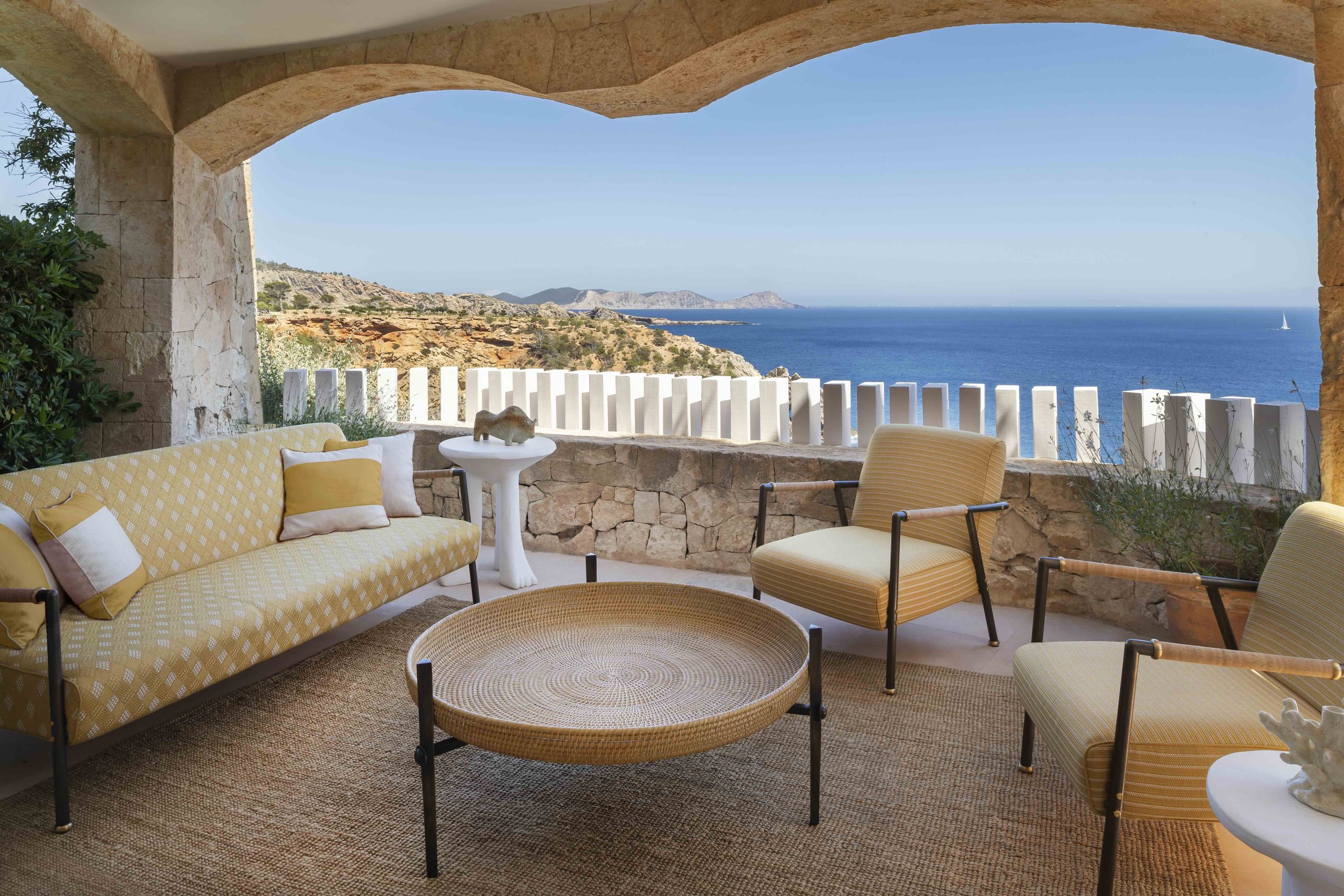
When Fahad Hariri talks about the house he keeps in Porroig, on Ibiza‘s southern coast, he doesn’t talk about it as a design project. He talks about it the way he talked, in an earlier conversation with this magazine, about the objects he lives with more broadly: not for what they are, but for what they evoke.
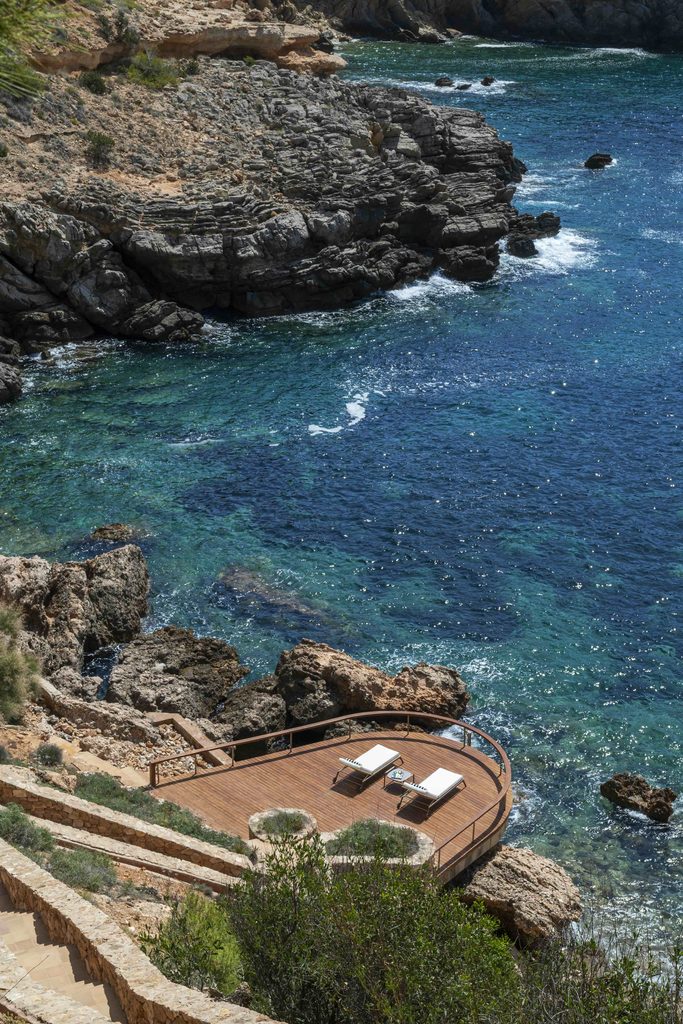
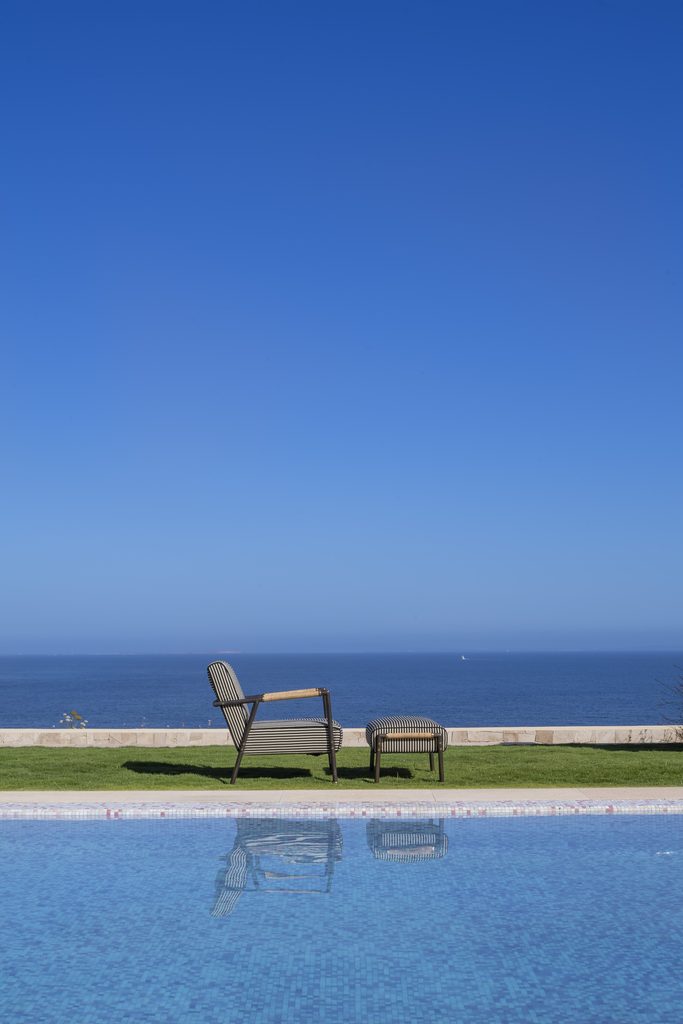
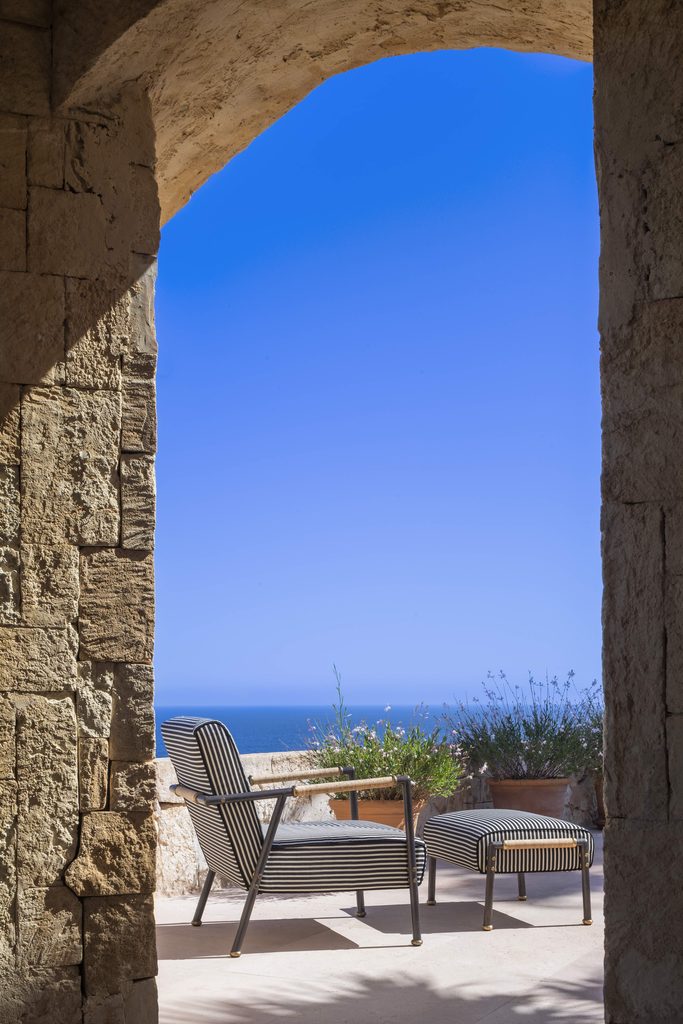
The house, roughly 600 square metres set on 2,500 square metres of land, eight bedrooms deep, facing Formentera and a short walk from two of his favourite restaurants, Es Xarcu and Jondal, is where that philosophy gets tested against an actual roof and eight actual bedrooms.
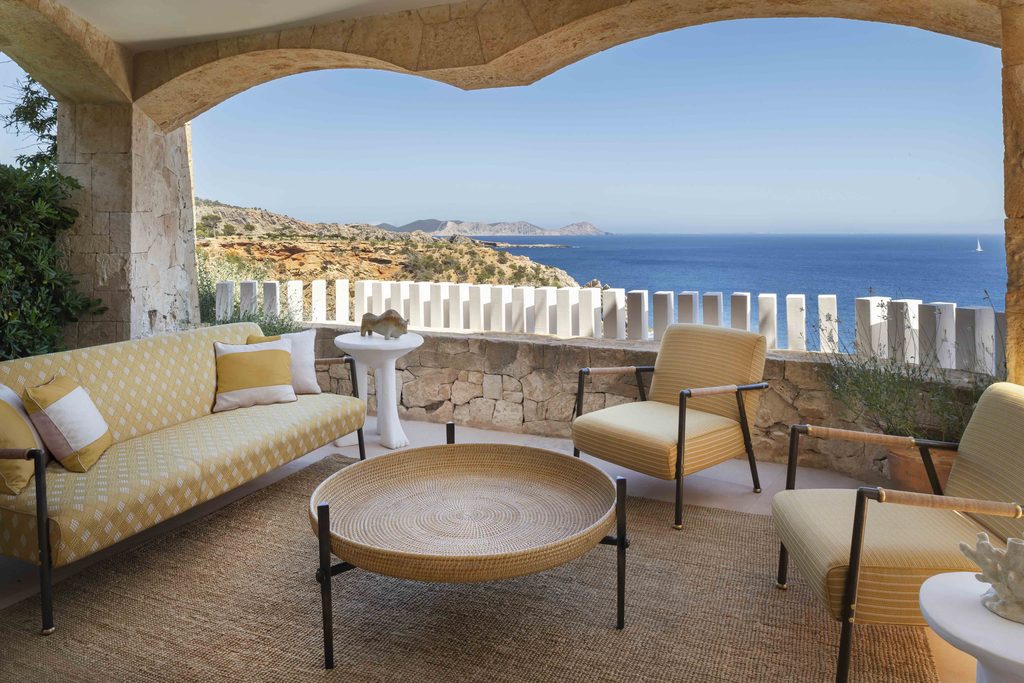
Hariri found the property through an estate agent and left its architecture untouched, considering it complete as it stood. He has touched it up most years since, never as a full renovation. He brought the project to PINTO as a client, in the mid-2010s, when the Paris house founded by Alberto Pinto was being run by Pinto’s sister Linda, with Pietro Scaglione serving as artistic director. Scaglione took the creative lead on Porroig, and Hariri has since described him as something of a mentor, crediting him with the poetic, softer sensibility PINTO brought to the house while he himself contributed his own eye as architect and collector. The collaboration went well enough that when Linda Pinto later looked to sell the firm, in 2020, she sold it to Hariri, who owns it today.
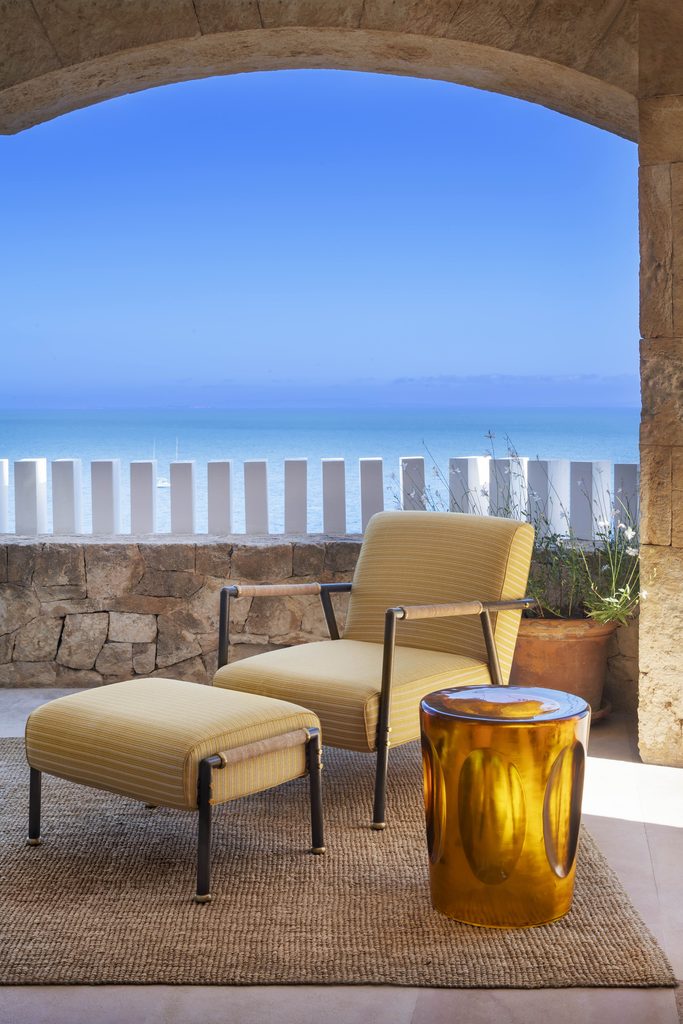
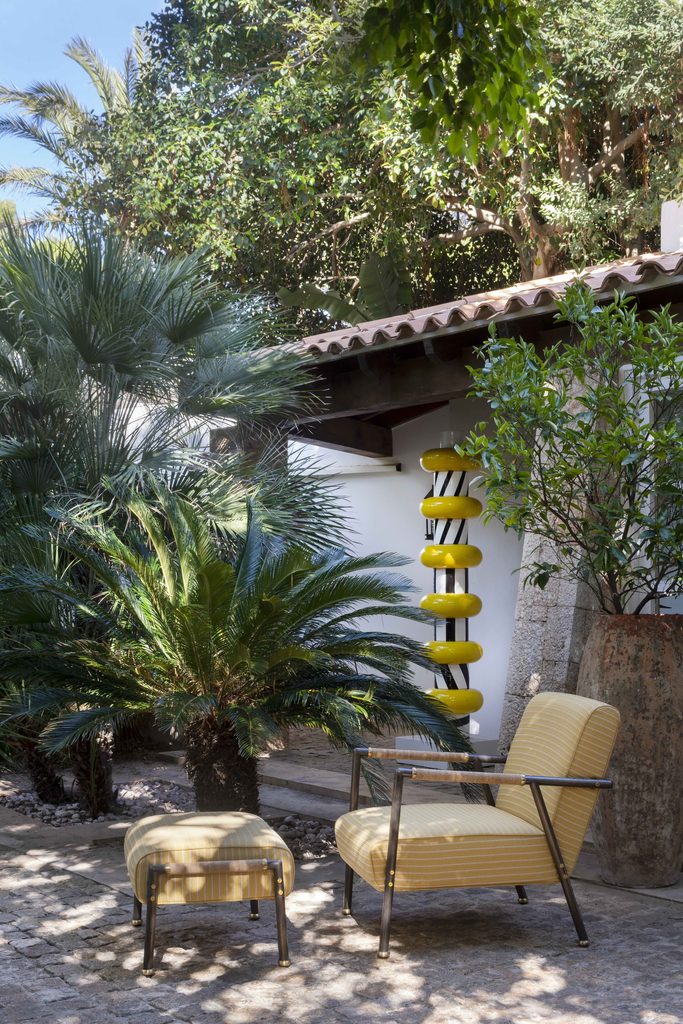
That word, rituals, is one he returns to often, and he’s described it before as a lesson in how luxury actually works: comfort built around “how we have breakfast, enjoy an espresso, or sit comfortably with a friend.” Porroig reads like an attempt to build a house entirely out of that idea, down to the fact that he never wanted it to look designed at all. He has said he wanted it to feel like a family home passed down over generations rather than decorated in one go.
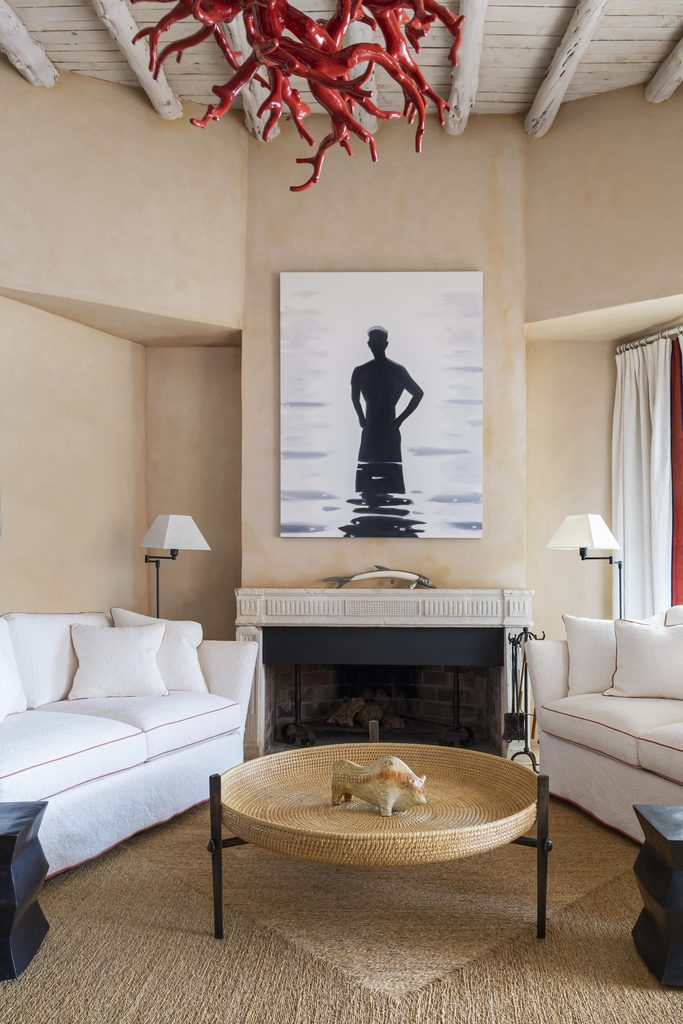
The furniture throughout does the work of implying decades that never actually happened. A Pierre Chapo coffee table, the model known as T22 “Oeil” for the eye-shaped cut through its solid oak top, sits in the living room. Nearby, a cuir de Cordoue leather screen, a nineteenth-century Italian dining table, a pair of neo-Gothic chairs and a console attributed to Charles Moreux sit as though none of them were bought in the same decade, let alone the same year. Two candelabra by César, sculptural rather than strictly functional, complete the room. The overall effect, one Hariri has pointed to directly, is of a house that might have been furnished by antique collectors decades ago and simply handed to him intact.
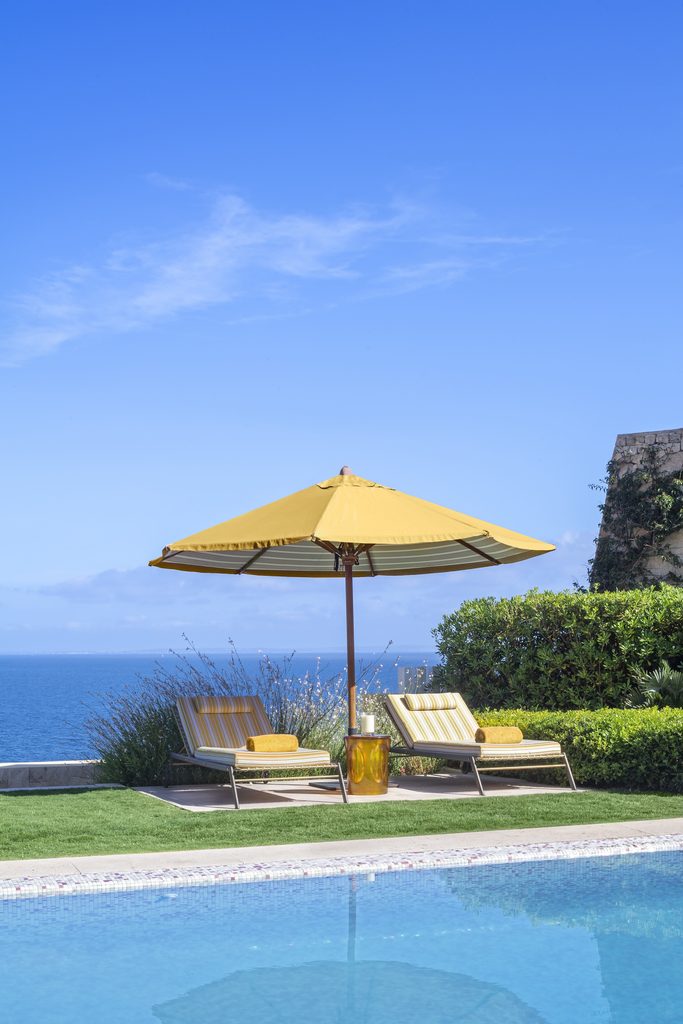
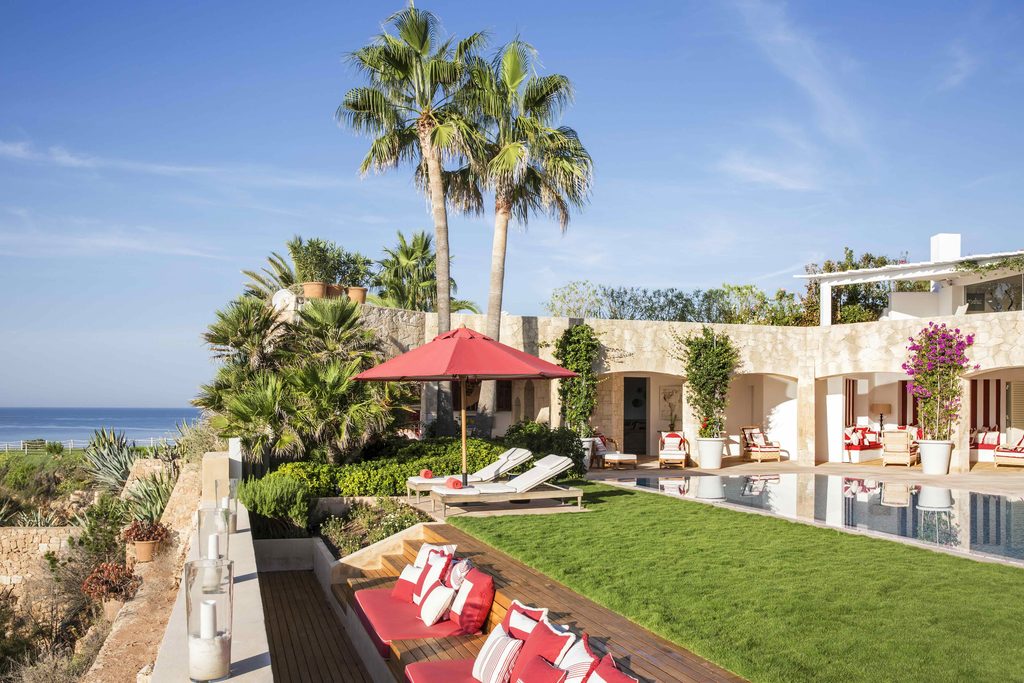
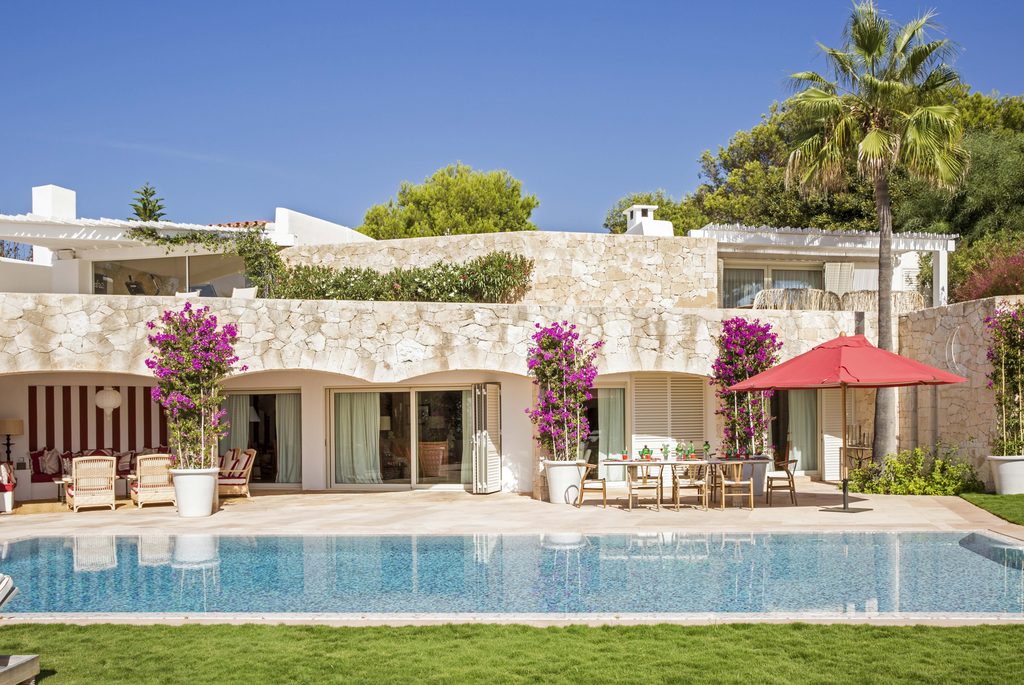
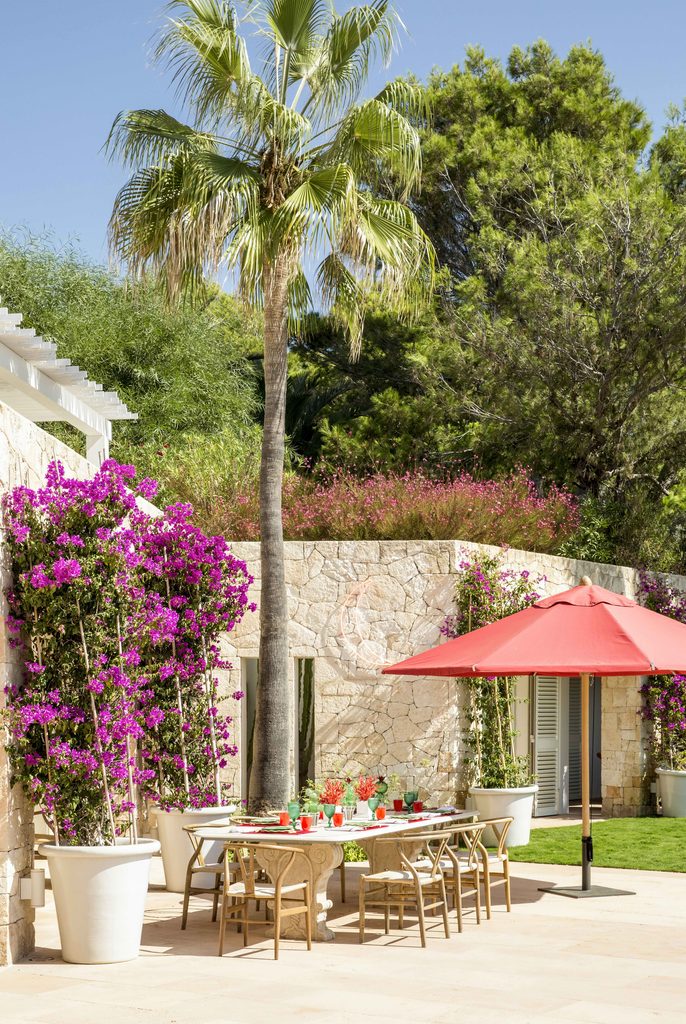
That instinct for accumulated time runs into the outdoor spaces too, where Sutherland supplies most of the seating: sunbeds in off-white fabric edged in red, teak bridge dining chairs holding lanterns filled with branches painted coral, and, in the sea-facing lounge, armchairs and a sofa arranged around a six-legged table in plaster designed by the American John Dickinson. A ceramic tulipière from the Dutch house Pols Potten sits within reach of it, and four paintings by Nada Trad, including one titled Femme déjeunant, are fixed to a run of vintage shutters rather than hung on the wall behind them.
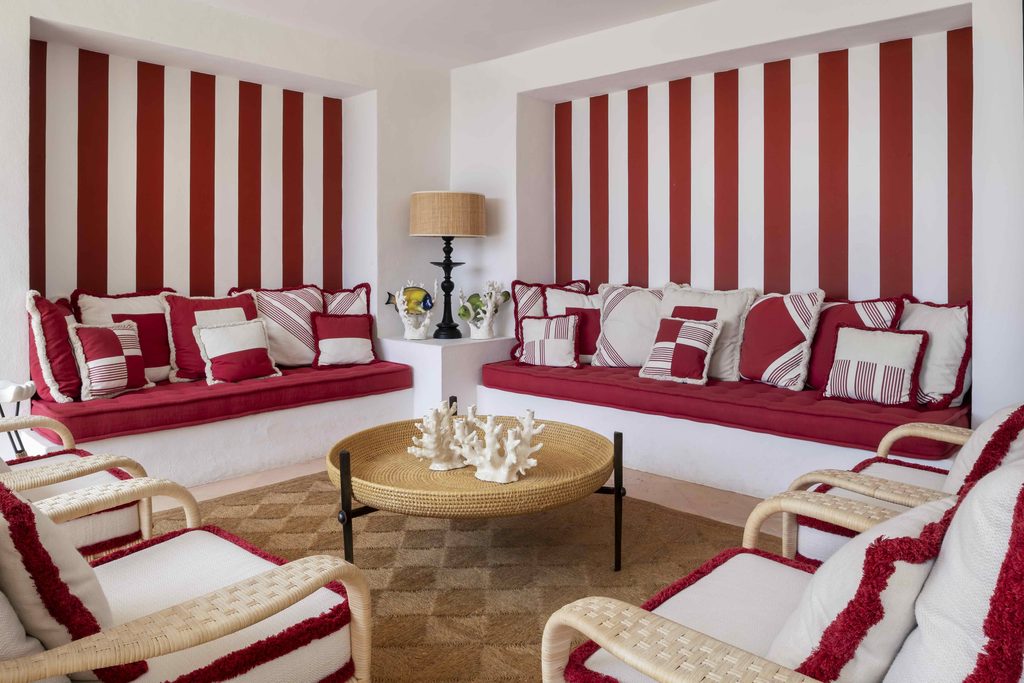
Under the covered porch, a coffee table made to measure in iron and polished stone is ringed by rattan armchairs from Bonacina, the Italian house that has been weaving furniture since 1889. Cushions built up through fabric assemblage sit against red-and-white stripes and a vintage straw-shaded lamp. Two ceramic traditions meet a few steps away: a set of seventeenth-century Delft plates displayed against pieces woven from agave fibre made in southern Spain, and, separately, a run of azulejo tiles from the house Alma Viva showing a seventeenth-century port scene. On a console found at the flea market, a cluster of 1950s French wooden sculptures sits beside an unattributed photograph, overexposed, of construction workers on a site in Dubai.
The hallway is arranged as a face-off: an untitled work in blue-lacquered wrought iron, made jointly by L.A. II (Angel Ortiz) and Keith Haring, on one wall, and a carved-wood moucharabieh piece by the artist Susan Hefuna on the other. Between them, a large brutalist console in sculpted wood carries a carved totem fitted with drawers, a wooden vase, and, mounted above, an ornament in gilt bronze with partial enamelling. A pair of oak Bridge “Denis” armchairs, designed by Guillerme et Chambron and reupholstered in orange, marks the end of the passage.
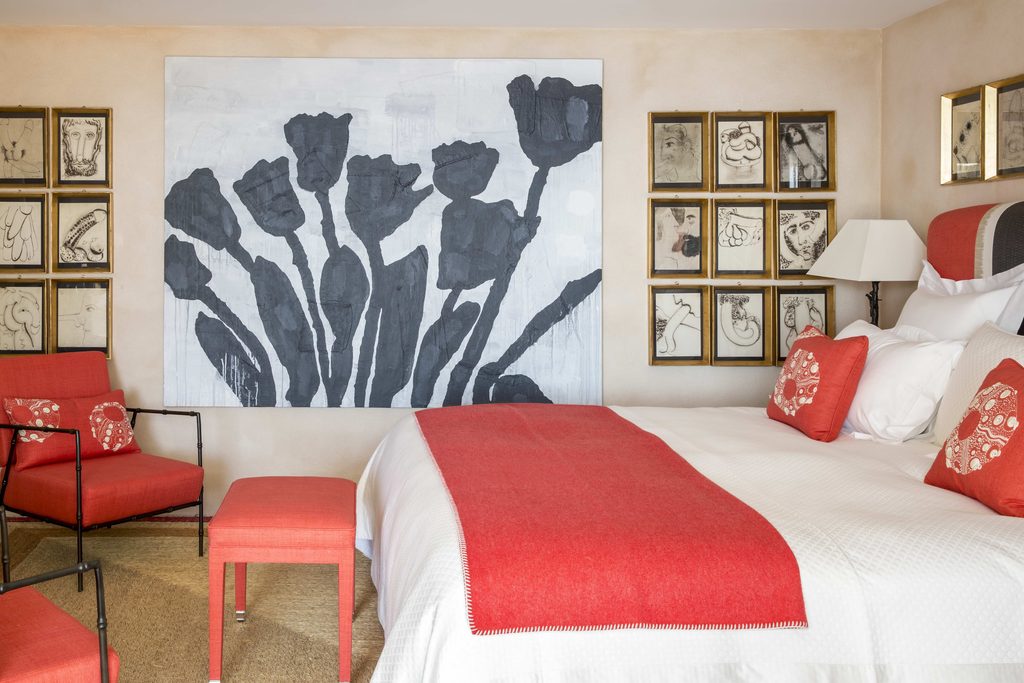
In the master bedroom, a 2006-2007 photograph by Taryn Simon, its full title running to a description of an avalanche-control charge in Colorado, hangs above a couch covered in Pierre Frey fabric. A table finished in tortoiseshell holds ceramic vases by Roger Capron next to contemporary Murano glass, flanked by vintage leaf-shaped armchairs sourced from Portuondo, with a 1950s French ceramic lamp on a metal table close by. A second Capron piece, a vase à oreilles, sits near a three-door cabinet in veneered wood, the Armoire AAA designed by Marcel Gascoin and produced under the Arhec edition around 1950. The two walls flanking the bed each hold one work: an oil painting, Cavité III, by Gérard Traquandi, and a photograph by Claudio Abate documenting Jannis Kounellis’s 1969 installation 12 Horses at Rome’s Galleria l’Attico. A pair of plaster wall sconces by Serge Roche, patinated and dated to around 1960, finishes the room.
For his children, the house shifts register entirely. Their play area, designed by PINTO specifically for the purpose, is built around a red cabin raised on stilts, set against red-and-white stripes and shaded by canvas, the same graphic language as the rest of the house scaled down to a child’s size. In a second children’s room, the lighting comes from a different tradition altogether: a 2009 floor lamp, the Svarva, designed by the Swedish pair Anna Lindgren and Sofia Lagerkvist for Ikea, paired with a chest of five drawers painted locally in Spain. A 2002 ink drawing by the Lebanese artist Fadia Haddad and a vase by Niki de Saint Phalle hang nearby.
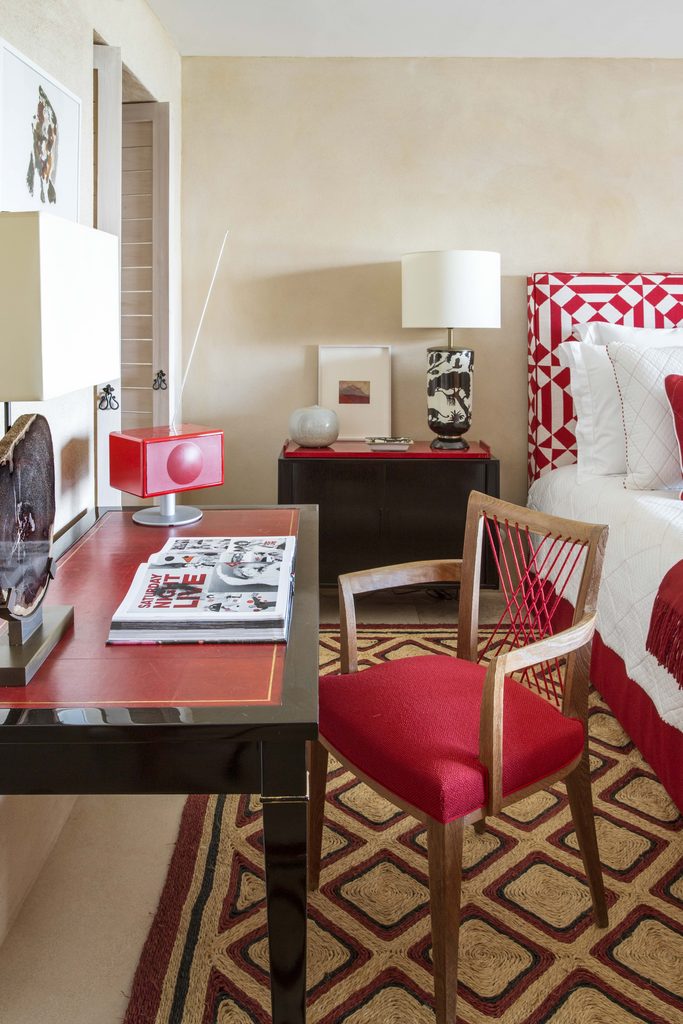
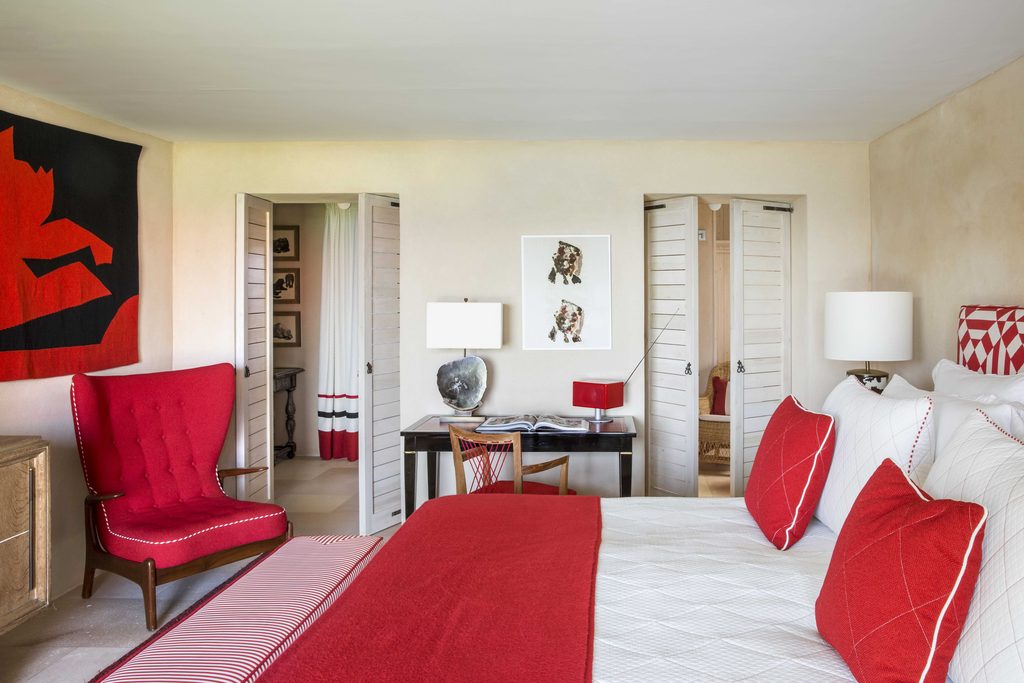
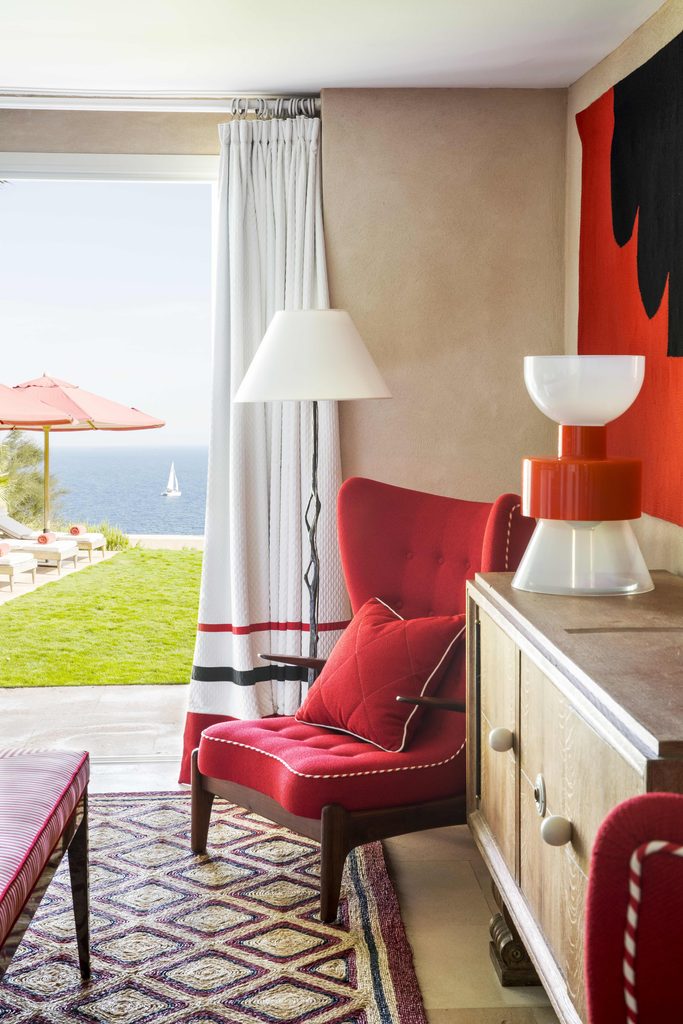
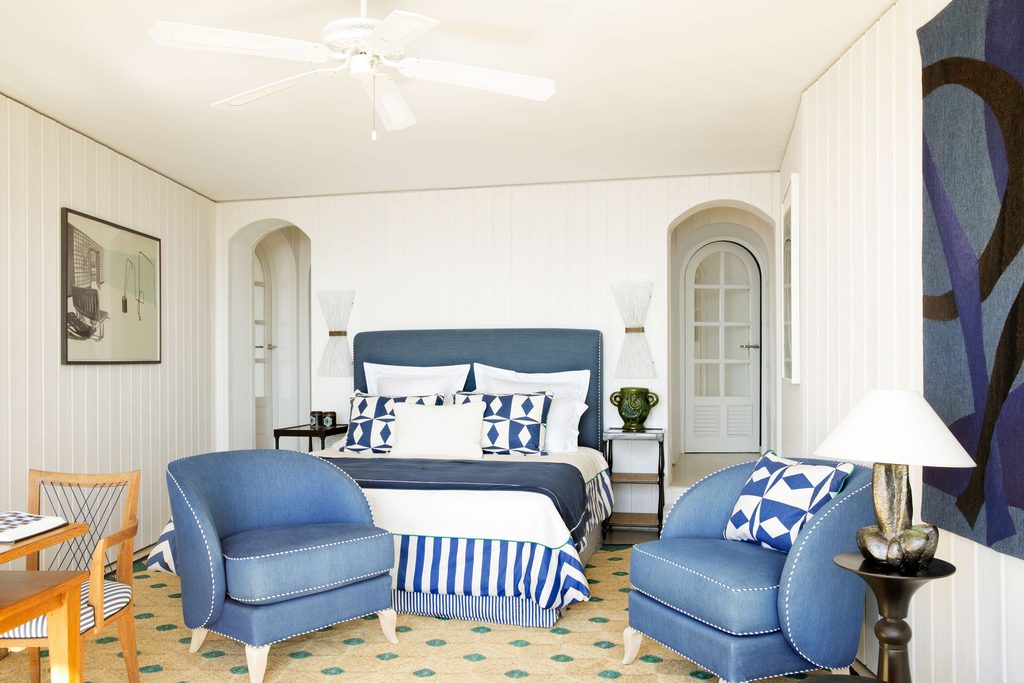
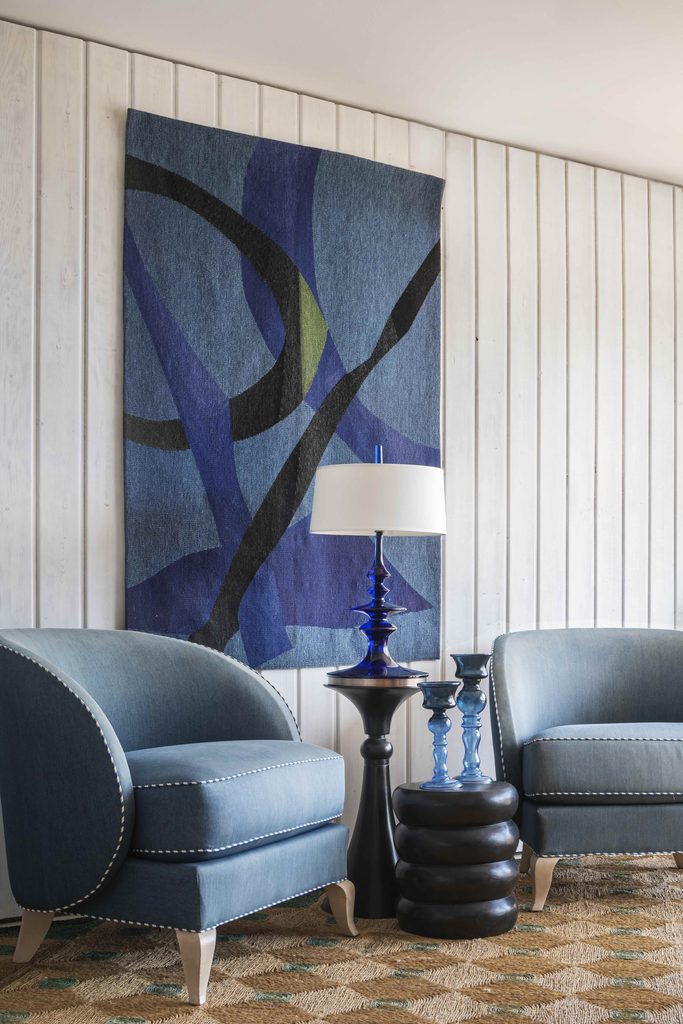
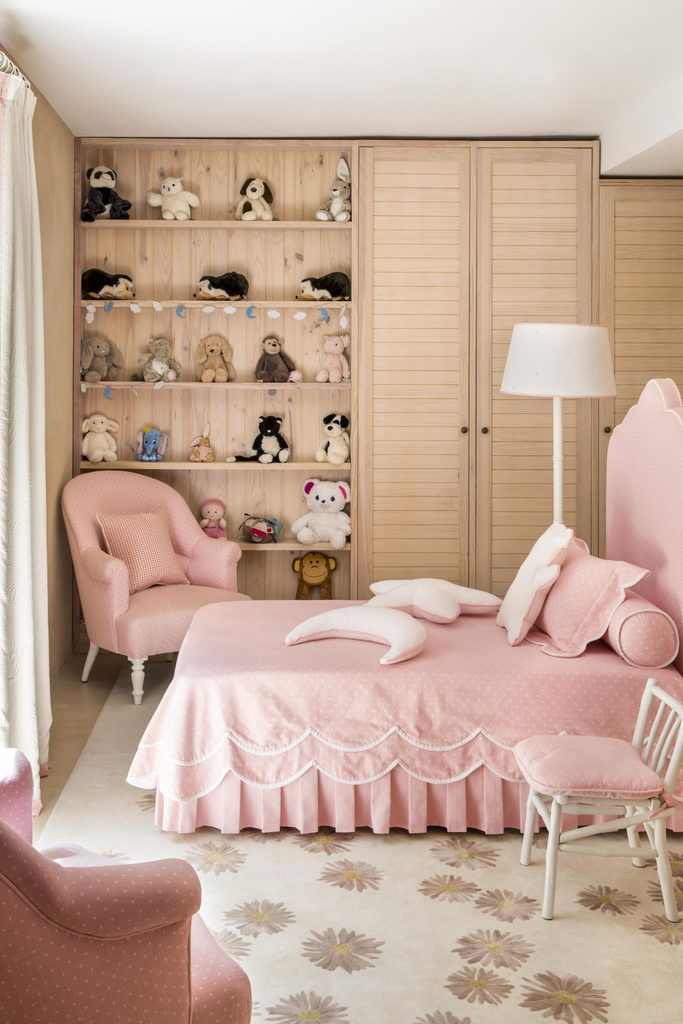
Several of the remaining bedrooms are organised around a single colour each, reds and corals, blues, a combination of coral and black, orange, pink, yellow, taupe and white among them. The blue room holds an untitled French tapestry from around 1960, a bronze helix lamp on a marble base from the 1970s, a black-patina bronze side table and a pair of light-wood armchairs upholstered in blue. The orange room takes its cue from a bed of PINTO‘s own design. The pink room is the most committed of all of them: a pair of house-shaped wardrobes in pink lacquered wood, a banquette, a pair of crapaud armchairs, a scalloped bedspread and a rug patterned with daisies. Further guest rooms lean on texture rather than a single object: a made-to-measure sofa piped in grey and ivory surrounded by vintage armchairs and footrests; a set of limited-edition erotic drawings by Piero Fornasetti above a headboard in black, white and coral with shell-embroidered cushions; a headboard in graphic red-and-white fabric set against a black-and-white leopard print from the French house Asiatides; curtains trimmed in red, white and black to a PINTO design; and, in one room, a flea-market lamp and a vintage Italian armchair beside a glass vase that Ettore Sottsass designed for Venini.
The art in the house is spread rather than concentrated, with works by Pier Paolo Calzolari, Anselm Kiefer, Marina Abramović, Alex Katz, Jannis Kounellis, Youssef Nabil and Jack Pierson turning up in bedrooms and hallways as often as in the living room. Asked for a favourite, Hariri points to the César candelabra near the entrance, its form broken apart yet still structural, and a photograph by Youssef Nabil, Ahmad in a Djellaba.
It’s the kind of answer that tracks with something he’s said elsewhere about how he collects at all: “I trust instinct first and understanding second. Only afterwards do I step back and understand why I was drawn to something.” He’s compared the objects and art in a home to flowers on a tree, present with no obvious function yet somehow holding the whole thing together, “we are the tree, and the objects we choose… are its flowers.” Porroig, more than any interior he’s built since taking over PINTO, reads like the place he tested that idea on first, letting the placement of things follow feeling rather than any fixed plan. The finished house, in his own shorthand, comes down to four words: modern, layered, intimate, vibrant.
He’s since started applying the same logic somewhere much bigger than a house, a hospitality vision he has described as staying sensitive to place while it scales across hotels internationally, carrying the same emotional intelligence he applies to private homes. Porroig, on that evidence, was never really a side project. It was the proof of concept.