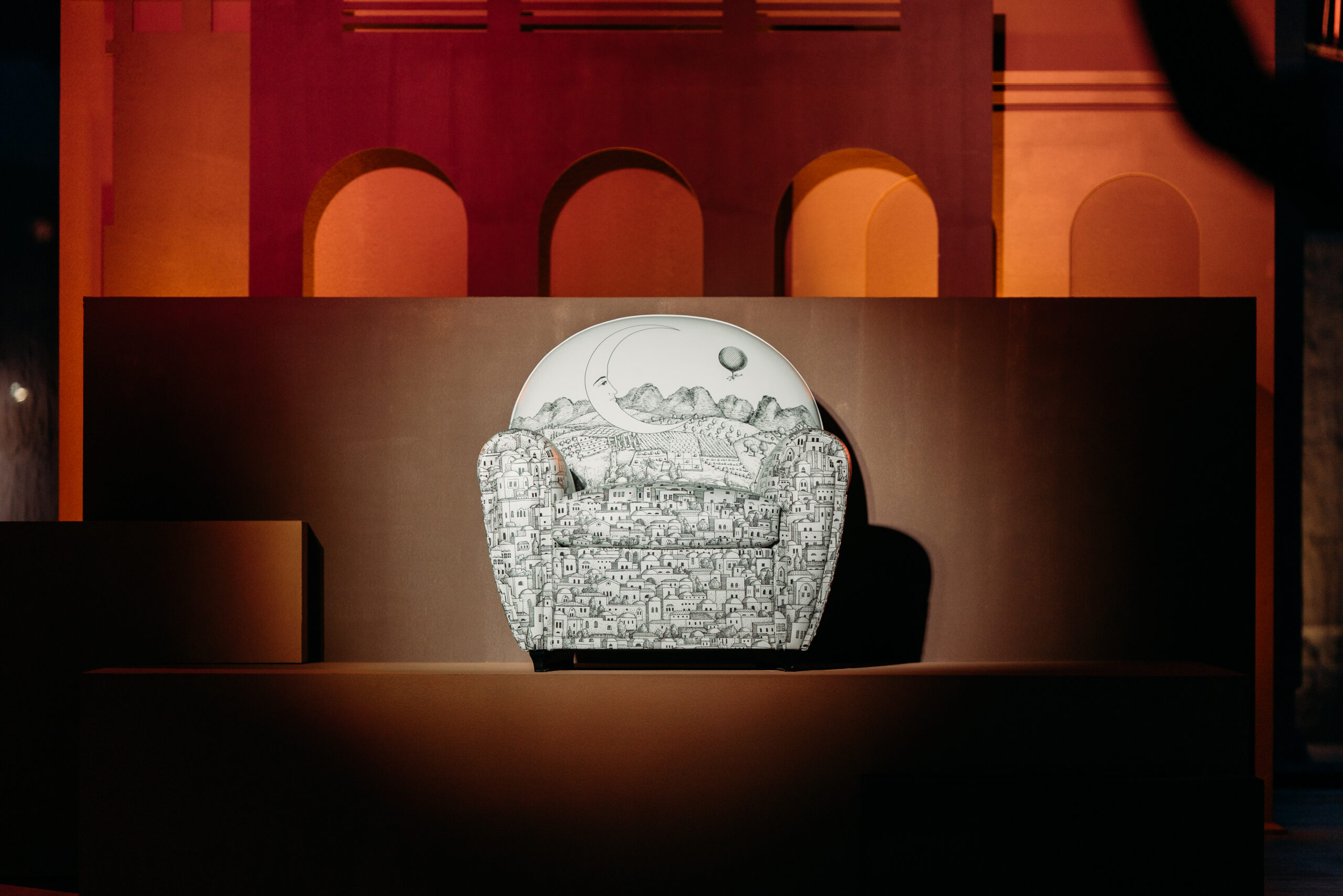
Collaborations in design often arrive with fanfare, yet the most enduring ones feel less like marketing gestures and more like conversations resumed. When Poltrona Frau and Fornasetti meet, it is not a collision of logos but a dialogue between two visual languages: one rooted in leather, proportion, and industrial savoir-faire; the other in illusion, archive, and the poetic excess of image.
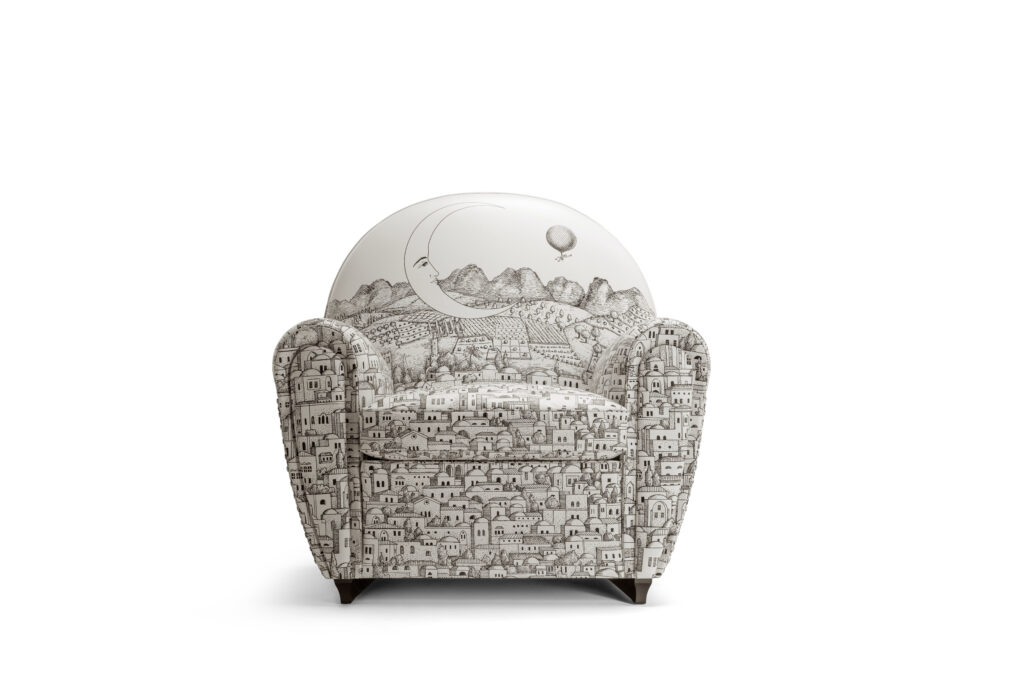
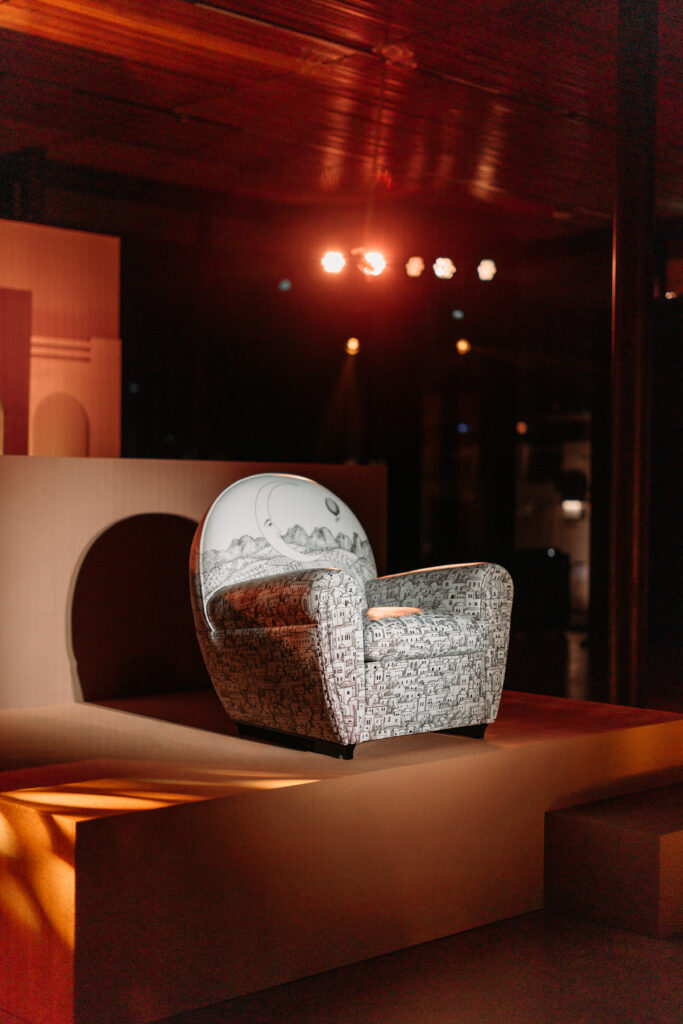
Their latest chapter unfolds through the Vanity Fair XC Middle East Limited Edition, a reimagining of an armchair whose silhouette dates back to 1930. Originally known as model 904, later christened Vanity Fair, it has long embodied a particular Italian notion of comfort: enveloping yet composed, bourgeois yet quietly radical in its compact geometry. The XC evolution refined its proportions for contemporary living, but its archetypal presence remained intact.
What shifts here is not the structure, but the surface — and with it, the narrative.
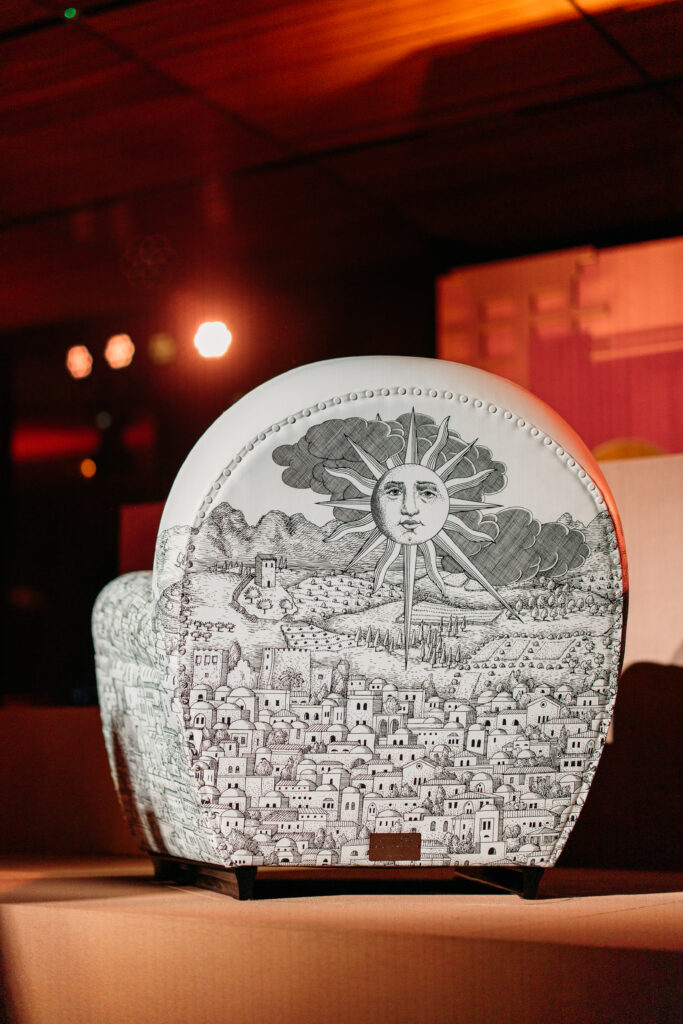
From the vast Fornasetti archive emerges Mediterranea, a décor first conceived in 1949 by Piero Fornasetti as wallpaper. A cityscape of rooftops and domes, windows and improbable perspectives, it has always hovered between architecture and dream. In this edition, Barnaba Fornasetti revisits the motif, introducing sun and moon symbols that allude to the rhythm of Ramadan — the celestial markers of beginning and end, absence and return. A lone figure floats across the sky, suspended from a balloon, waving. It is an unexpected gesture, almost childlike, within an otherwise meticulous composition.
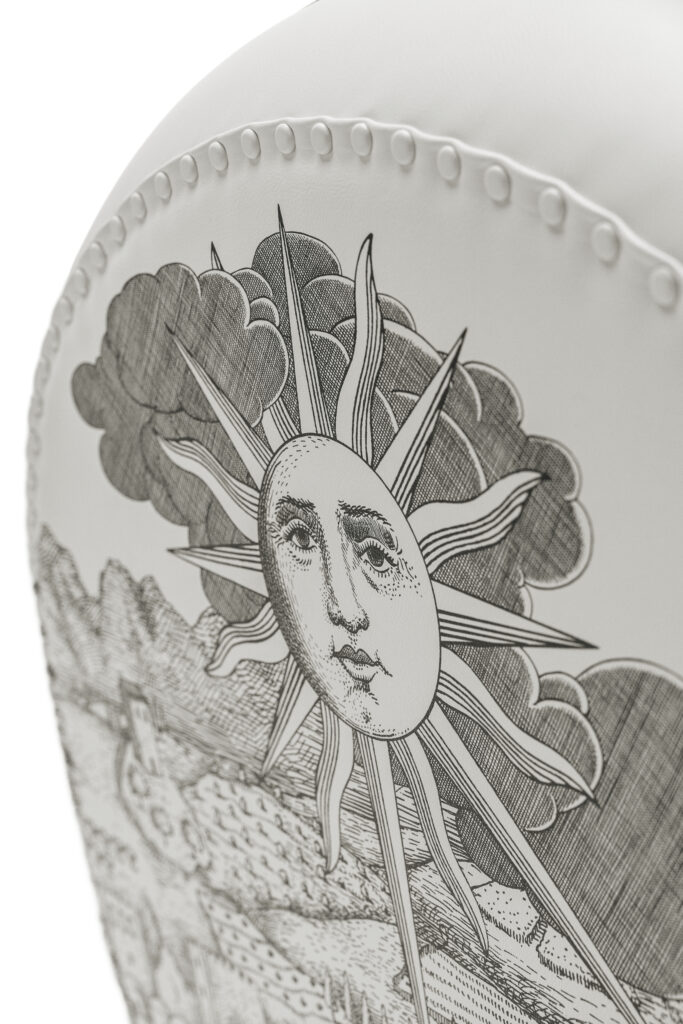
Printed digitally onto Pelle Frau® ColorSphere Impact Less leather, the image acquires a new material tension. Leather — historically associated with tactility, permanence, and patina — becomes the ground for a graphic narrative. The technique borrows from fashion’s precision processes, yet the result resists slickness; the grain absorbs ink, giving depth to the linework. It is a contemporary form of marquetry, where the tool is no longer a chisel but a printer calibrated to respect hand-drawn intricacy.
There is symbolism in the numbers as well: twenty-eight pieces marking twenty-eight years of Poltrona Frau’s presence in the Gulf. But beyond commemoration, the project gestures toward something larger — the way Italian design houses now speak fluently with other geographies without diluting their identity. Rather than applying a superficial “Middle Eastern” code, the collaboration works through metaphor: sky, light, time, gathering.
Ramadan is not rendered as ornament; it is evoked as atmosphere.
This is perhaps where such collaborations find their true value. Not in exclusivity — though the pieces are indeed limited — but in their capacity to test the elasticity of icons. How many narratives can an armchair contain? How many surfaces can leather hold before it ceases to be merely upholstery and becomes landscape?
In an era where brand alliances proliferate endlessly, the Poltrona Frau x Fornasetti dialogue suggests another possibility: that when two houses with distinct archives meet, infinity is not excess but potential. The object remains finite — numbered, signed, placed in a room — yet the cultural references it carries are inexhaustible.
An armchair, after all, is a place to sit. But in rare cases, it is also a place where worlds overlap.