Every generation seems to rediscover the Odyssey on its own terms. Some of us first met it as a school assignment, a text that felt locked in the past — gods behaving badly, a hero who couldn’t get home, a queen left waiting. And yet the story keeps resurfacing, almost on schedule, as though it never really belonged to any one era to begin with.
Enter The Odyssey, currently in cinemas — Christopher Nolan’s attempt to prove exactly that. Matt Damon leads as Odysseus, alongside Anne Hathaway as Penelope, Tom Holland as Telemachus, Zendaya as Athena, Charlize Theron as Calypso, Lupita Nyong’o as Helen of Troy, and Robert Pattinson and Samantha Morton rounding out the ensemble. Shot entirely on IMAX cameras across six countries, it is Nolan at his most maximalist — and, for once, his most classical.
While costume designer Ellen Mirojnick has been widely credited for translating the myth into wearable power — collars, cuffs and hammered gold that read as archaeology as much as adornment — the film’s true world-building belongs to production designer Ruth De Jong. Her instinct, from the start, was to resist the soundstage. Ithaca was built into the clifftop ruins of Castello di Santa Caterina, on the Sicilian island of Favignana. Troy rose again at Aït Benhaddou, in Morocco, complete with a temple to Athena. Calypso’s Ogygia is the white dunes of Dakhla, in the Sahara. Circe’s island was shot on the Moray Firth in Scotland; the Underworld, on the black sand beaches of Vik, Iceland. “Everything is built on location, in an environment,” De Jong has said of her approach — a philosophy of weight, texture and material honesty that, it turns out, has been quietly circulating through the design world for a while now.
The return of ancient material
We’re surrounded by images that move too fast to leave much of a trace: AI-generated, endlessly scrollable, gone in a swipe. Maybe that’s exactly why there’s such an appetite right now for things you can actually hold: uneven surfaces, visible thumbprints, objects that seem to have already survived something. Fashion got there first: the Greco-Roman aesthetic has been resurfacing on runways and red carpets for several seasons now, a rediscovery of Magna Graecia that runs in parallel to Nolan’s film rather than in response to it. Design is catching the same wave, for much the same reason: after two decades of high-gloss, screen-ready surfaces, the hand-thrown and the imperfect are having their moment again.
It is worth remembering that this is not a new impulse. Picasso, working at the Madoura pottery studio in Vallauris in the 1950s, shaped pitchers and vases that borrowed directly from the elongated bodies and high, curved handles of Attic amphorae, a reminder that the greatest artists of the twentieth century were already looking backward, toward the Aegean, for their forward-looking forms. Today’s designers are doing something similar, if in a different register: fewer mythological scenes, more silhouette, texture and weight.
The amphora, updated
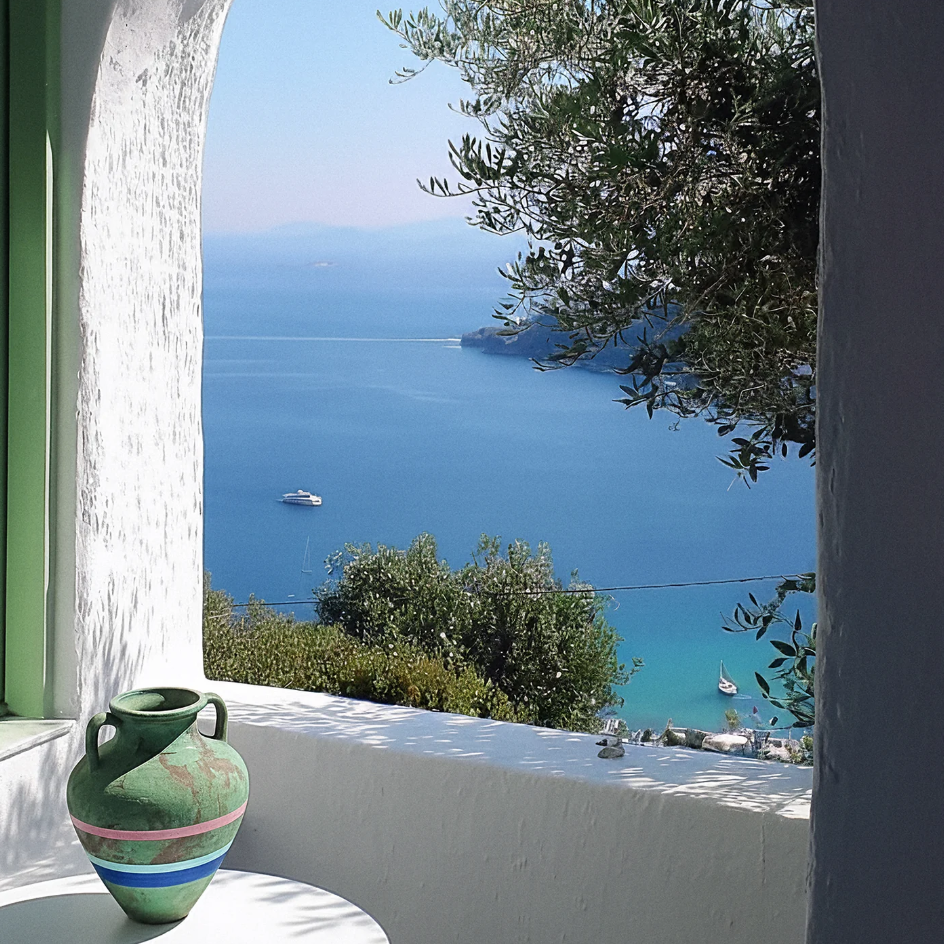
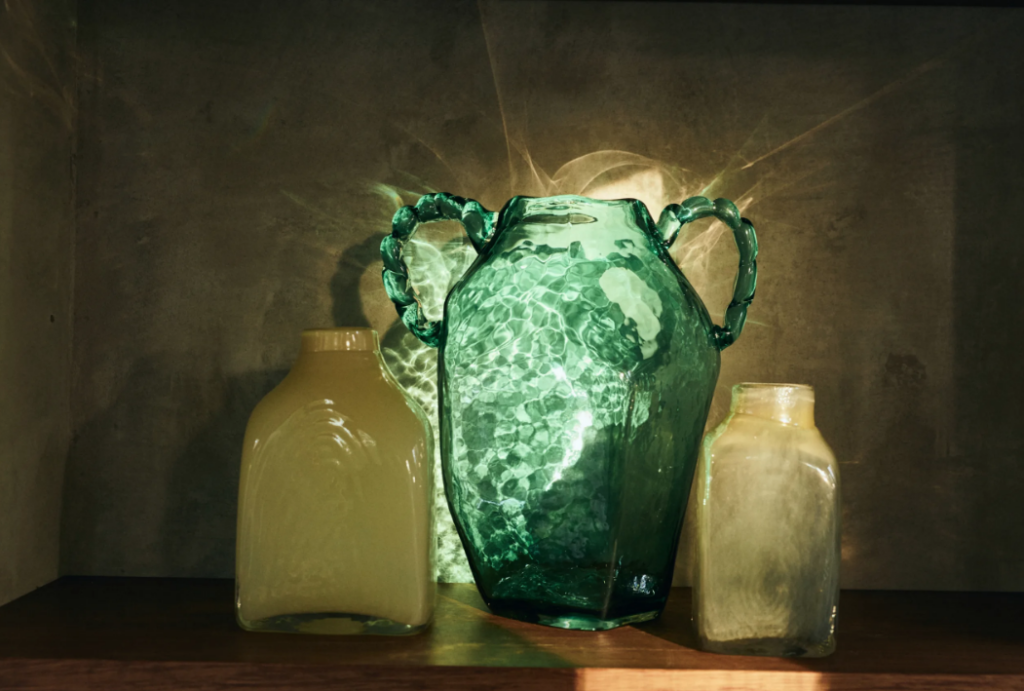
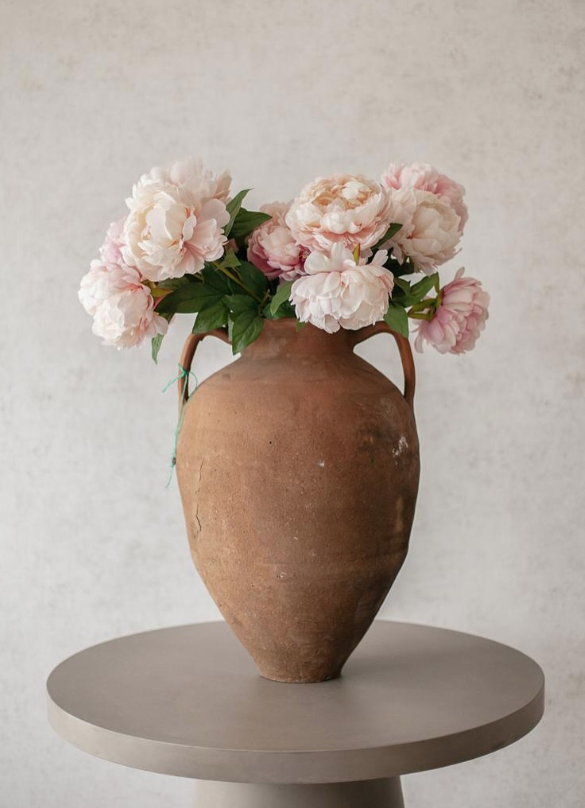
Three designers, three completely different takes on the same silhouette — proof that the shape itself has become a kind of open-source language. Artemest’s Pop Pot, by Nettuno Octane, is a digitally modelled amphora produced through 3D printing and finished by hand with an artisan patina, its oxidised bronze surface reading like something pulled from a shipwreck rather than a printer ($2,680; a limited edition, five to six weeks to make). HK Living’s Gemstone Amphora, designed by Nienke Sikkema, keeps the two-handled body but casts it in sapphire-toned hand-blown glass, closer to jewellery than pottery. And then there’s the real thing, or close to it: Jerra’s Ancient Aegean Pot, sourced antique, vintage or carefully reproduced, patina and all — a reminder of what the other two are actually quoting.
Gods at the table
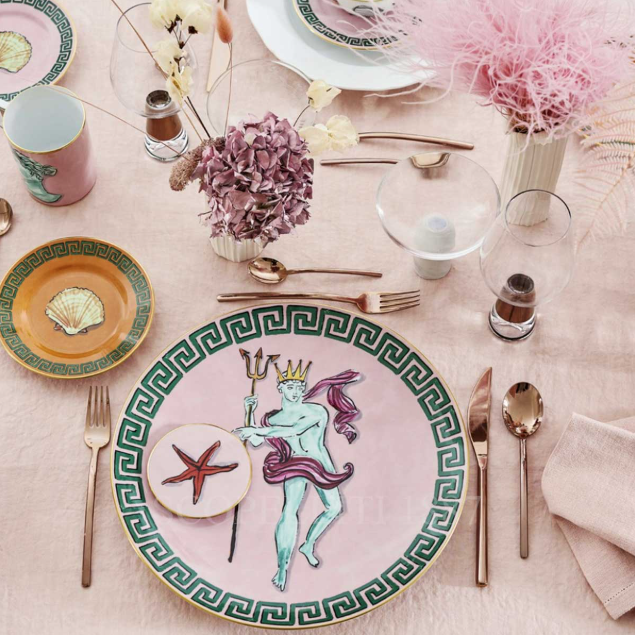
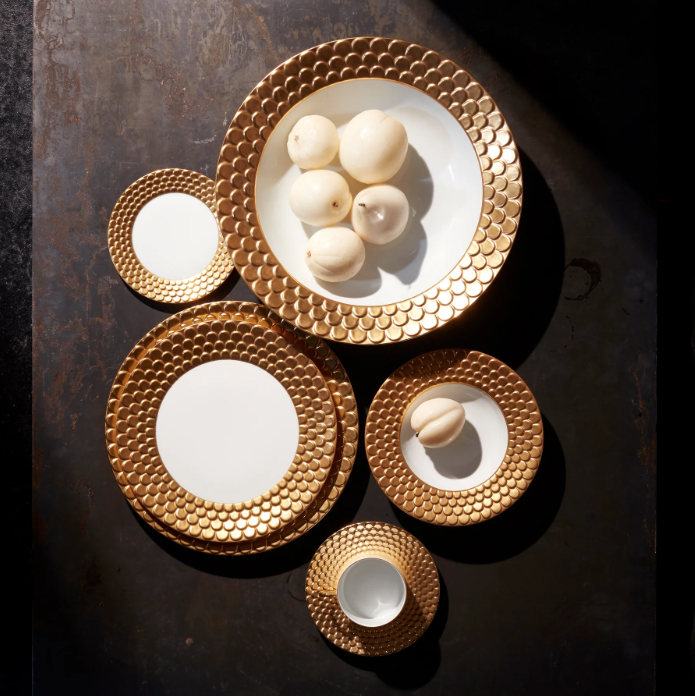
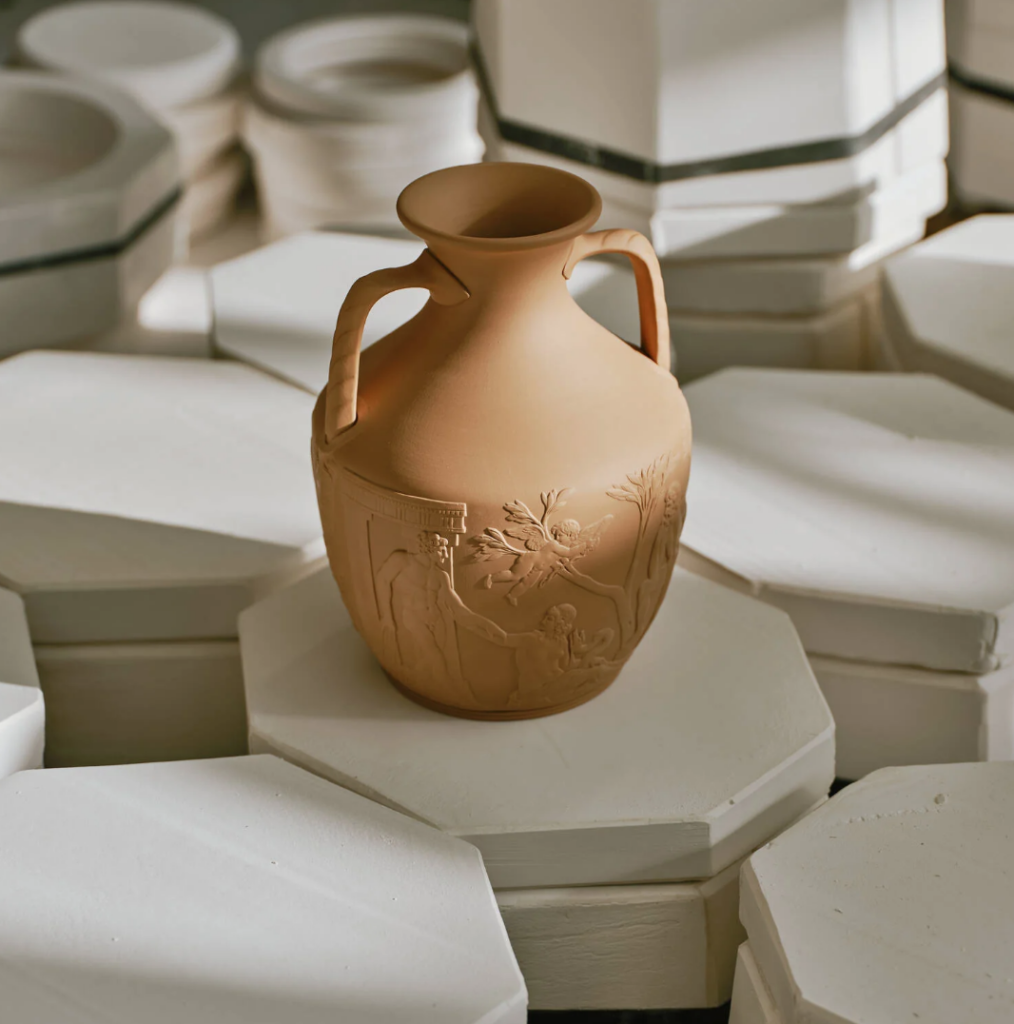
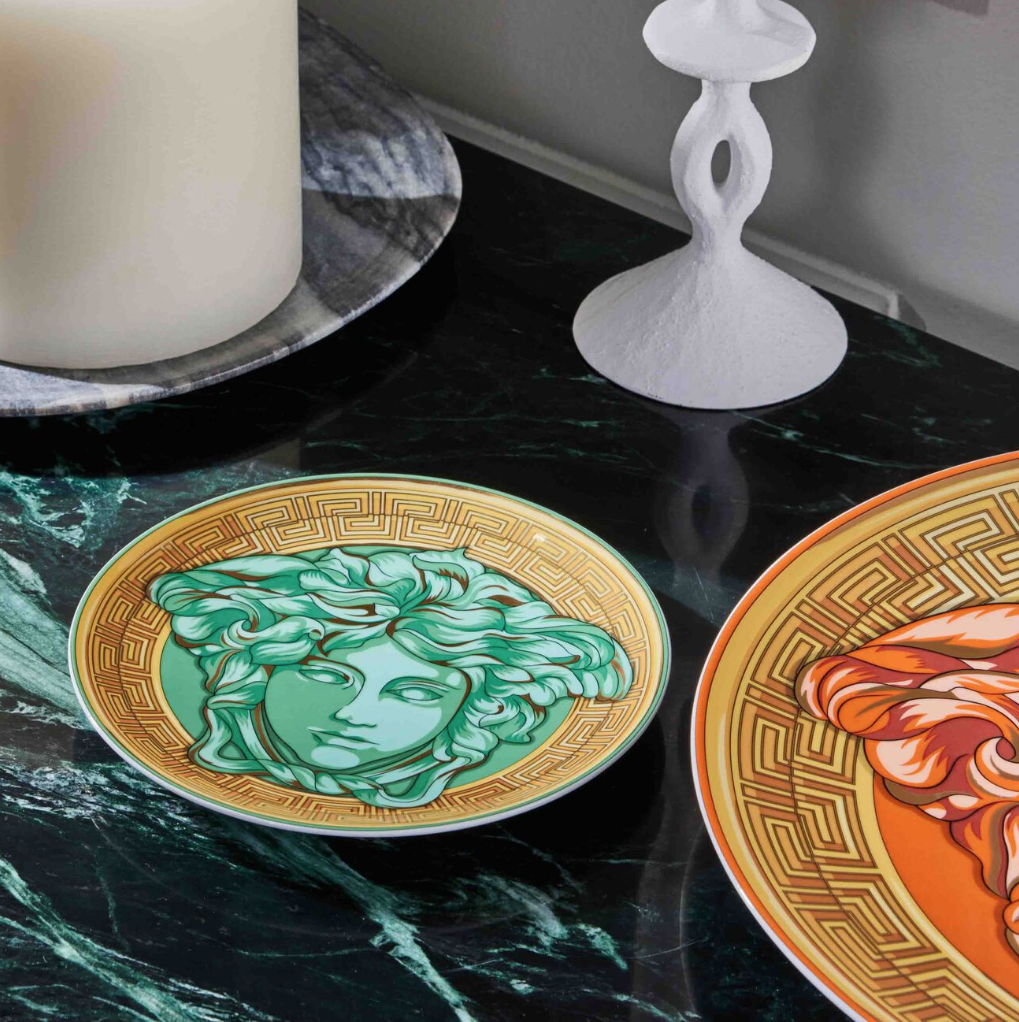
If the film puts gods in the room, the tableware puts them on the table. Ginori 1735’s Il Viaggio di Nettuno designed by Luke Edward Hall, sets a sea deity in the spirit of Salacia, Neptune’s bride, against Grecian green and pure gold thread; it’s maximalist mythology, meant to be lived with daily rather than looked at from a distance. L’Objet’s Aegean collection takes the quieter route: the name itself comes from the Greek aiges, “waves,” and the 24-karat gold wave motif, hand-painted onto fine white porcelain, is essentially a Greek key pattern that learned to swim. Wedgwood’s Portland Vase, reissued in a flaxen Jasperware colourway, is the historical anchor of the group, its bas-relief is a direct homage to the Barberini Vase, the Roman glass original excavated in the sixteenth century and still, arguably, the single most influential vessel in the history of Western design. And no table like this is complete without Versace‘s own myth: the Medusa Amplified Green Coin bread and butter plate, made with Rosenthal, rings the Gorgon’s head — the house’s founding emblem since Gianni Versace first borrowed it from antiquity — in a gilded coin motif, proof that Medusa has been quietly setting the table since the 1990s.
Sculptural fragments
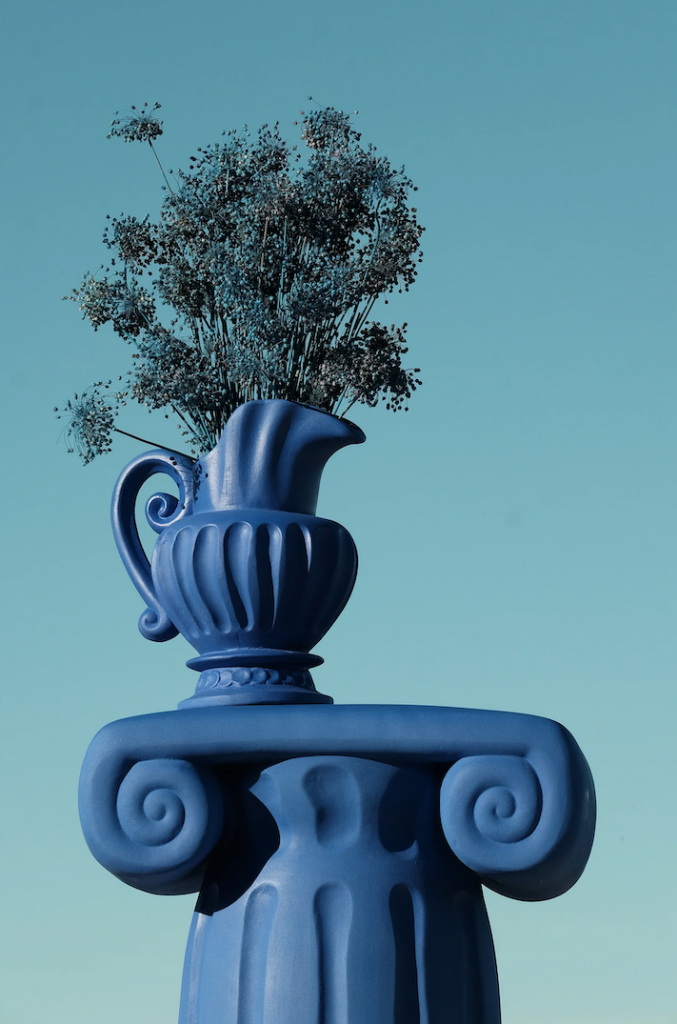
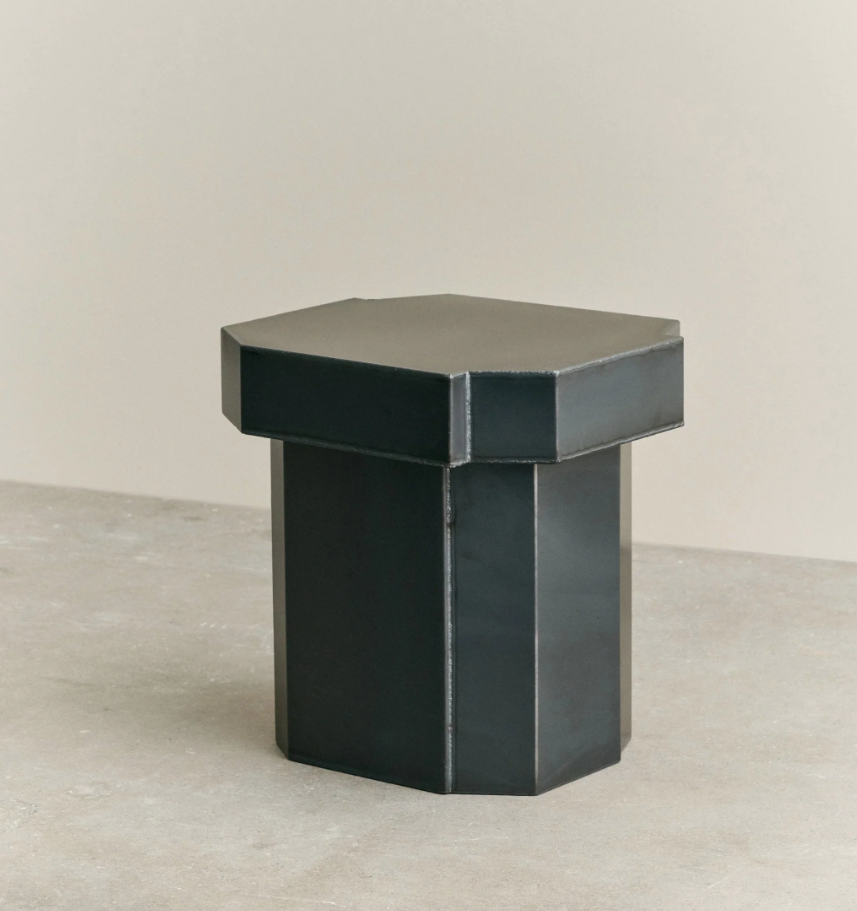
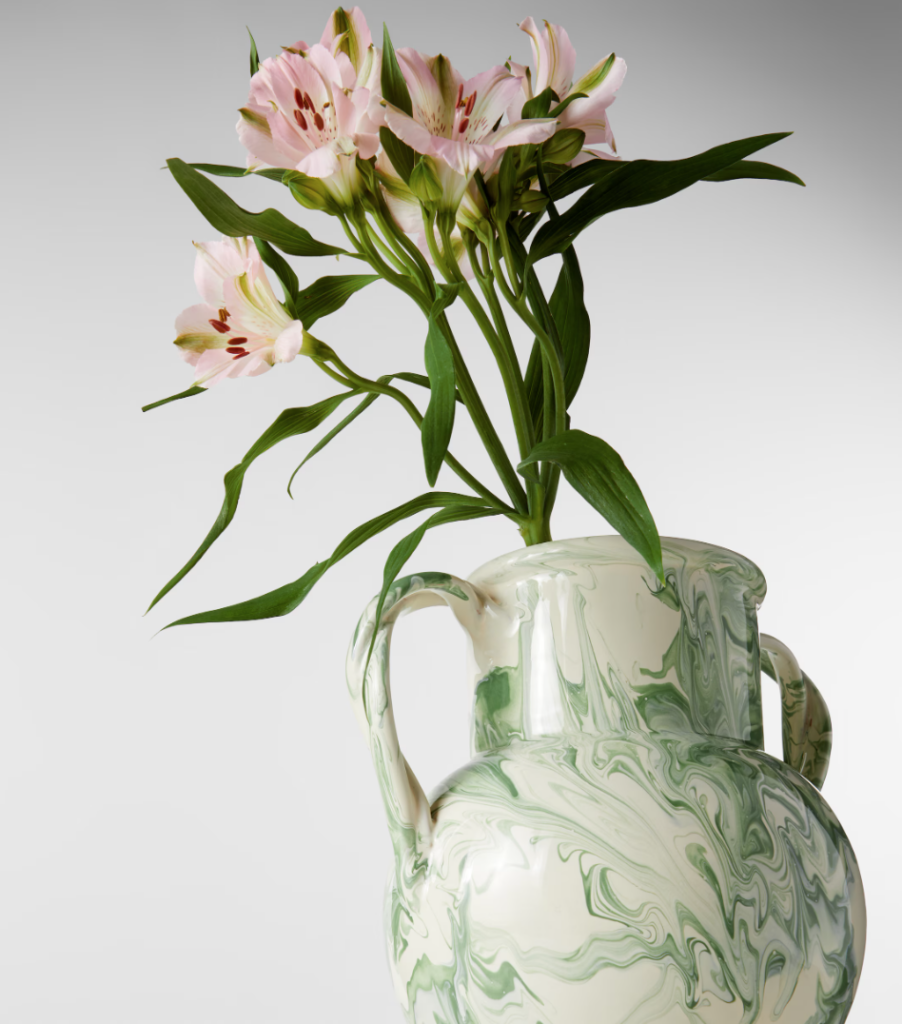
Some pieces skip the vessel altogether and go straight for the architecture. Seletti’s Terracotta Capitel Blue, designed by Antonio Aricò, turns an Ionic capital into a plinth for its own miniature ewer, column and vase fused into one object, painted in a single flat, matte blue. Louise Roe’s Funki Stool takes the same impulse toward abstracted classical geometry into furniture: a faceted, plinth-like form in dark steel that reads more like a fallen fragment of entablature than a seat. And Cabana’s marbled ceramic vase, in swirling greens, translates the veined stone of antiquity, the marble of temples and tombs, back into something you can put flowers in.
The showstopper
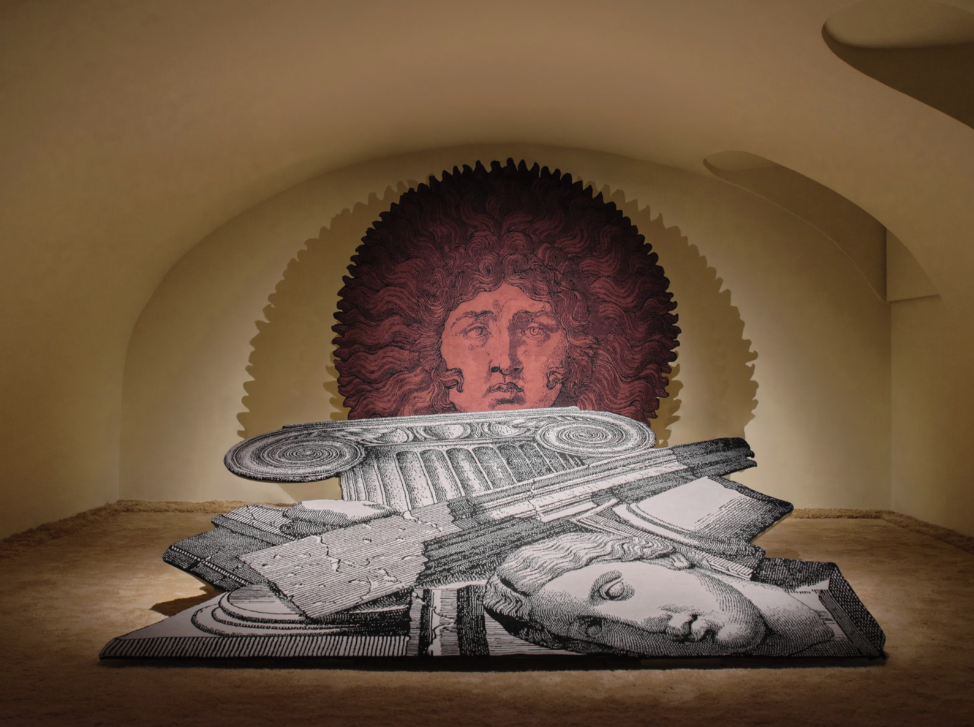
For the room that can carry it: Fornasetti and cc-tapis’s Rovine Classiche rug, hand-knotted in Nepal from 100% New Zealand wool, lays a Fornasetti trompe-l’œil of a colossal head, a fallen Ionic capital and scattered architectural fragments directly onto the floor: borderless, freeform, cut to the shape of the scene itself. It’s less a rug than a stage set for ruins, which might be the most honest way to describe what this entire trend is doing to a room.
Maybe that’s the real link between Nolan’s film and the objects sitting on shelves and consoles right now: none of these shapes are new. They keep getting pulled back up, dusted off, put back into circulation, the design equivalent of a jar hauled up from a wreck. And an object that arrives already carrying that kind of mileage might be the closest thing to real luxury design has left to offer.