There is a particular paradox at the heart of renovating a family home. Architecture is asked to change, sometimes radically, while preserving something that cannot quite be drawn on a plan: continuity. A house inhabited over time accumulates not only rooms and objects, but habits, memories and emotional associations. To redesign it is therefore never simply to correct its architecture. It is to decide what deserves to remain legible, what can disappear, and what kind of future the existing structure might still contain.


This tension gives Oldham Residence, a 4,500 square foot home in Toronto’s Etobicoke neighbourhood, its particular intelligence. Completed in 2026 by Ksenia Berkovich, founder and principal designer of Fancy Interiors Studio, the project began with a house that had evolved through successive additions and interventions. Its architecture carried the evidence of different moments, but lacked a coherent language. Rather than abandon a property deeply embedded in the family’s history, its owners chose to reimagine it for another generation.


Berkovich’s response is less about imposing a recognisable aesthetic than establishing continuity. Sightlines, thresholds and surfaces are treated as a single spatial grammar. Curves recur quietly through millwork and corners, dissolving some of the rigidity of the existing structure, while a restrained material vocabulary gives otherwise distinct rooms a sense of kinship. Marble, onyx, timber, microcement, fluted glass and textured wallcoverings are not deployed as isolated decorative gestures. They become connective tissue.

This is particularly evident in the living room, where architecture, furniture and art resist easy separation. Curved bespoke millwork frames a marble fireplace, while a mural by Phillip Jeffries introduces a quieter, almost atmospheric layer behind it. Berkovich’s own custom onyx coffee table occupies the centre of the room not as a conspicuous statement piece, but as another geological presence within the composition. Elsewhere, a painting commissioned from Tatiana Fedankova enters into a similarly intimate dialogue with the interior.


Stone, indeed, becomes one of the house’s principal languages. Its role is not merely ornamental. In the primary bathroom, Calacatta Gold extends across walls and countertop before resolving into integrated sinks, collapsing the conventional distinction between surface and object. The powder room pursues the idea more dramatically through a custom backlit onyx basin, transforming an essentially functional element into something closer to illuminated architecture.


The same logic appears in quieter gestures. Microcement wraps walls and reappears in the shower, where its continuous surface suppresses visual interruption. At the entrance, custom marble handles turn the ordinary action of opening a door into a tactile encounter with material. In the family room, the media wall is absorbed into a composition of custom cabinetry and microcement rather than treated as technological equipment demanding attention.


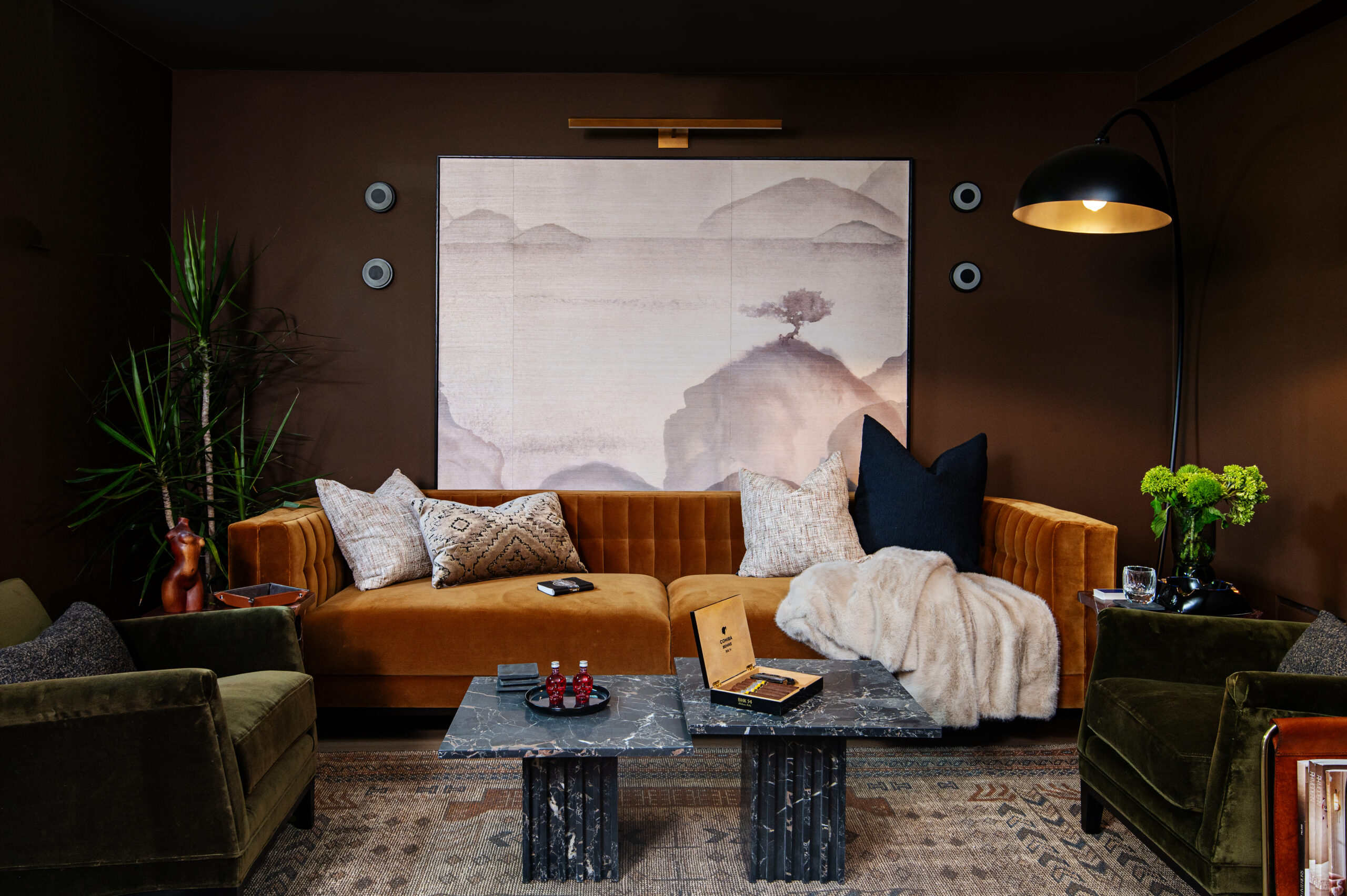
What emerges is a form of luxury increasingly detached from spectacle. Its value lies in resolution: the junction that disappears, the storage concealed within millwork, the sink that can vanish beneath the kitchen surface, the object conceived for precisely one place. Even recognisable design names are absorbed into this larger narrative. Jonathan Adler ceramics, for instance, appear among the objects inhabiting the daughter’s bedroom, while Phillip Jeffries returns in the basement bar, where a mural contributes to a darker and more enveloping atmosphere.

Perhaps the most revealing aspect of Oldham Residence, however, is that all this precision ultimately serves something less tangible than design. The owners’ children are now adults and the family has welcomed its first granddaughter. The renovation therefore anticipates another cycle of occupation. This is not a house conceived around the fixed image of a particular moment, but around the possibility of duration.

That distinction matters. Contemporary residential design can too easily confuse newness with relevance, as though transformation required the removal of everything that preceded it. Oldham Residence proposes something subtler. Here, design becomes an instrument through which a house can absorb change without surrendering its identity. Materials age, families evolve, rooms acquire different meanings. Architecture, at its most considered, allows all three to happen.

In Berkovich’s hands, the renovation is consequently less an ending than a continuation: a house made coherent not by denying its past, but by giving that past somewhere to go.