Every year, Salone del Mobile transforms Milan into a city in acceleration. What is often underestimated is not the scale of the event, but the intensity with which it unfolds. Distances stretch, schedules compress, and the line between fair and city dissolves.
To experience it well is not about seeing everything, but about understanding how to move through it. From an Italian editor at Marie Claire Maison Arabia, a concise guide to navigating Salone del Mobile 2026.
Access and opening hours
Salone del Mobile 2026 is primarily reserved for industry professionals, including architects, designers, buyers, and press. Registration can be completed in advance through the official Salone platform to obtain an e-ticket.
The fair opens to the public on its final days, (Saturday 25 and Sunday 26). Opening hours generally run from morning to early evening, with slightly reduced hours on the closing day.
Understanding the geography
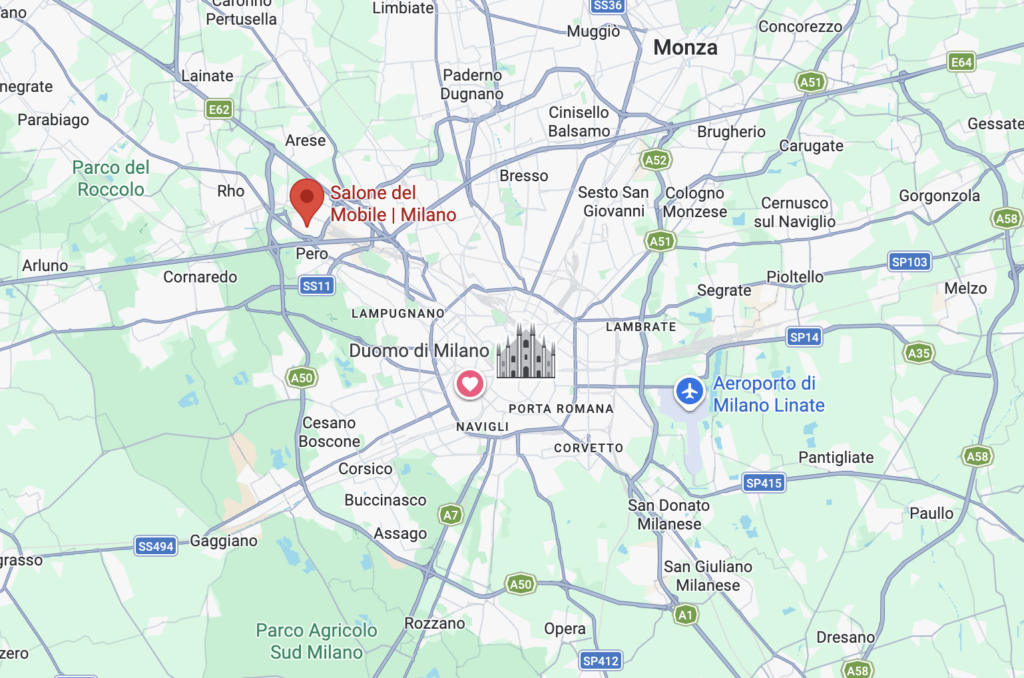
The first distinction is spatial. The Salone itself takes place at Fiera Milano Rho, located outside the city. Reaching Fiera Milano Rho from the city centre typically takes around half an hour to one hour, combining metro or train connections.
Milan, by contrast, disperses into districts. Brera, Tortona, and Isola become dense networks of exhibitions, installations, and temporary spaces. The experience shifts from structured navigation to discovery. Moving between these two conditions requires intention and organisation.
Getting there
Reaching Fiera Milano Rho by public transport is strongly recommended, particularly during peak times when traffic becomes congested.
The M1 metro line (red line) connects directly to Rho Fiera and links the fairgrounds to key areas of the city, including Porta Venezia and Duomo. The journey is efficient and, during design week, becomes an extension of the event itself, shared with a constant flow of visitors moving between the fair and the city.
Moving through the city
The metro remains the most reliable way to cross Milan, particularly during design week when surface traffic slows considerably. Lines connecting the city centre to Rho are essential in the morning, when the flow towards the fair is at its peak.
Digital tickets can be purchased through the ATM Milano Official App, allowing seamless access across metro, tram, and bus networks. Here you may find the metro map.
For shorter distances, electric scooters, available through platforms such as Lime and Cooltra, offer a practical alternative, particularly within central districts. Their use, however, requires attention to parking regulations, which are strictly enforced. Helmets are mandatory, they are generally placed inside the scooters.
Taking a Taxi in Milan
Milan operates through licensed taxi services rather than a dominant ride-hailing culture. The most reliable central numbers are Radio Taxi 8585 (+39 02 8585) and Taxiblu 024040 (+39 02 4040), both offering efficient dispatch and, in most cases, English-speaking operators.
For ease, booking through apps such as appTaxi ,itTaxi, Bolt or Free Now is recommended, allowing payment by card and avoiding language barriers.
Official taxis are white and can be found at designated stands across the city, particularly at airports, train stations, and major squares. Availability can fluctuate significantly during design week, especially in the evening.
As a general rule, it is advisable to confirm card payment before starting the journey. Fixed fares apply for airport transfers, with set rates between Milan and both Linate and Malpensa airports.
Language and etiquette
Milan operates with a quiet formality. Simple expressions such as “Buongiorno” (bwohn-jor-noh, good morning), “Grazie” (grah-tsyeh, thank you), “Scusi”(skoo-zee, scussi)and “Permesso” (per-meh-sso, sorry when passing through)remain part of the social fabric. Even minimal use signals attention and respect, subtly shaping interactions throughout the day.
Practical considerations
Beyond movement and scheduling, a number of smaller details shape how the week is experienced.
Pickpocketing can occur in crowded areas, particularly on public transport and around major hubs such as Centrale and Duomo. Bags should remain closed and carried with awareness, especially during peak hours.
While card payments are widely accepted, small amounts of cash remain useful for taxis, cafés, and informal settings. It is always advisable to confirm card acceptance before beginning a taxi journey.
Eating and timing
Milan follows its own daily rhythm, which becomes more pronounced during design week. Coffee is typically taken standing at the bar, a faster and more informal ritual than seated service. In Italy, cappuccino is considered a morning ritual and is rarely ordered after midday, particularly in more traditional settings.
Lunch generally falls between 12:30 and 14:30, while dinner rarely begins before 19:30. Reservations are essential throughout the week, even for casual restaurants, as availability becomes extremely limited. Stay tuned for our guide on where to eat.
Opening hours
Shops and services do not operate on a continuous schedule, they generally open at 10 am and close at 7:30 pm. Some close during the early afternoon, and many remain shut on Sundays or Mondays. Exhibition hours vary widely across the city, requiring careful verification in advance.
Pharmacies and essentials
Pharmacies, marked by a green cross, are distributed throughout the city and operate on a rotating system for night service. They remain a reliable point of assistance for both medical and practical needs. Here is a map with all the pharmacies.
Pacing the week
Salone del Mobile is physically demanding. Distances accumulate, and the density of appointments can quickly become overwhelming. Allowing time between visits, and resisting the urge to overschedule, often results in a more focused and rewarding experience.
A practical note
The Marie Claire Maison Arabia team is on the ground throughout the week. For recommendations, directions, or last-minute insights, follow us on Instagram.
Read here the official initiatives of Salone del Mobile.Milano 2026