Words by Allegra Salvadori | Images Courtesy of Nebras Aljoaib
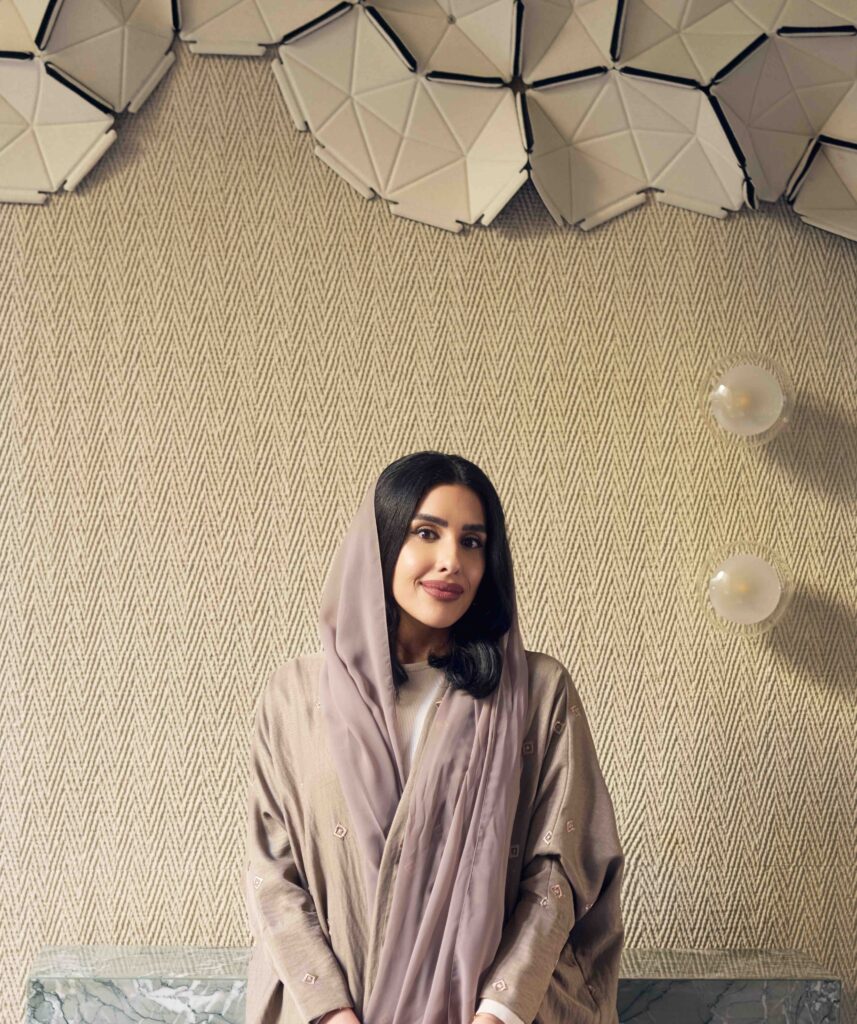
For this feature, Marie Claire Maison Arabia held an exclusive conversation with Saudi designer Nebras Aljoaib, whose installation Between Light and Stone for Noor Riyadh 2025 offered one of the festival’s most contemplative meditations on heritage and transformation.
For the fifth edition of Noor Riyadh 2025, Saudi designer and artist Nebras Aljoaib unveiled Between Light and Stone, a monumental installation that distilled a defining cultural question for the Kingdom: how does a nation move forward at extraordinary speed without losing what anchors it?
As Aljoaib expressed, “Between Light and Stone began with a question: how do we move forward without losing what anchors us?”
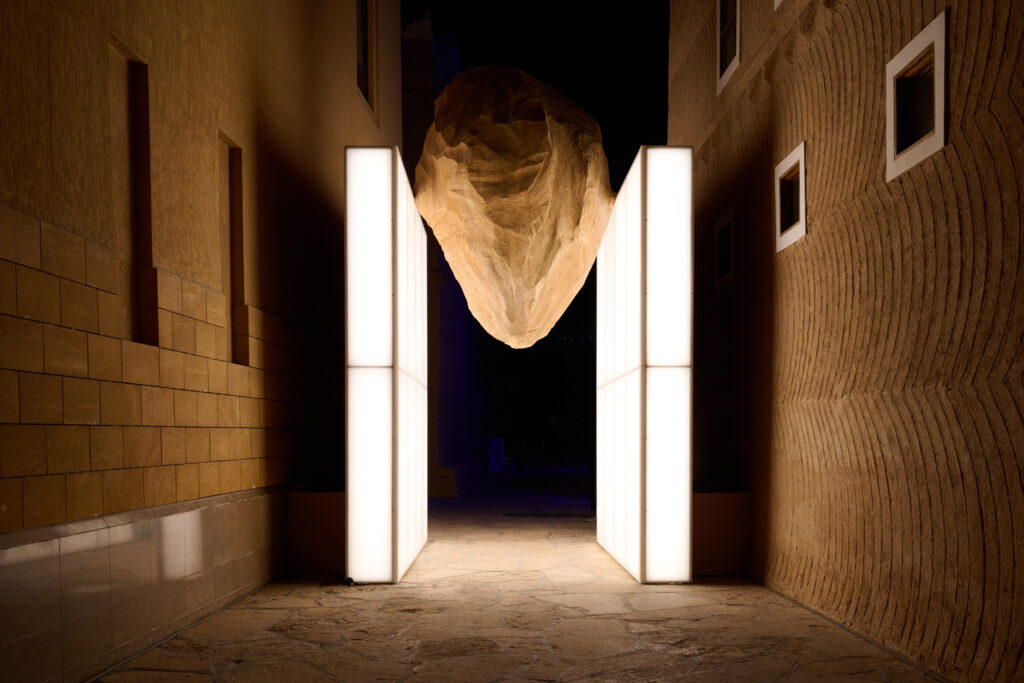

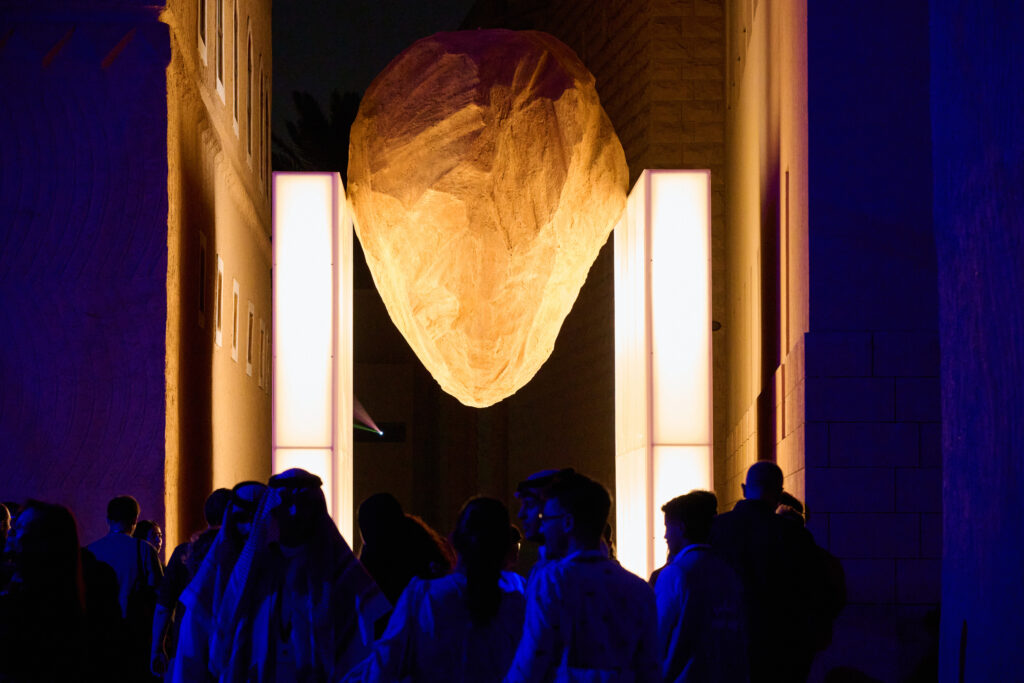
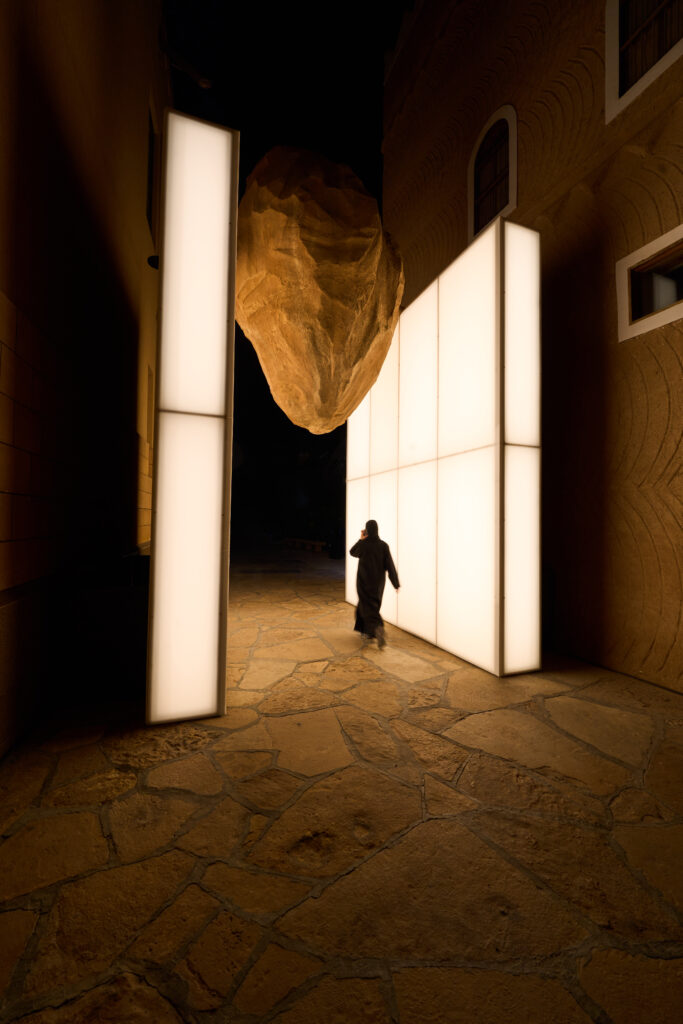
The work, situated within the King Abdulaziz Historical Center, framed this question through a poetic physical dialogue: a suspended boulder set between two luminous, reactive walls. The installation captured the tension between permanence and acceleration, a sculptural metaphor for a country negotiating continuity amid rapid transformation. “Installing this work at the King Abdulaziz Historical Center was intentional,” she reflected. “The site embodied continuity — the weight of Riyadh’s past — even as the city evolved around it.”
A Dialogue Between What Endured and What Accelerated
At the heart of the installation lay a raw, textured boulder — a material embodiment of endurance, ancestry, and the cultural foundations that shape collective memory. Opposing it stood two illuminated walls, smooth and vertical, their pulsing light echoing the optimistic momentum defining contemporary Saudi Arabia. “The suspended boulder embodied endurance — the histories, memories, and values that grounded us,” Aljoaib explained. “The illuminated walls spoke to acceleration, the extraordinary speed at which Saudi Arabia was evolving.”
Between these two forces, the installation created a moment of stillness — a spatial pause that carried emotional weight. “Holding these forces in tension created a moment of pause,” she said. “A space where transformation could be felt rather than simply observed.”
In this interplay of ancient stone and contemporary light, Aljoaib articulated a form of evolution that honored what came before without resisting progress — a transformation not of erasure, but of reinterpretation.
Interactivity as Emotional Architecture
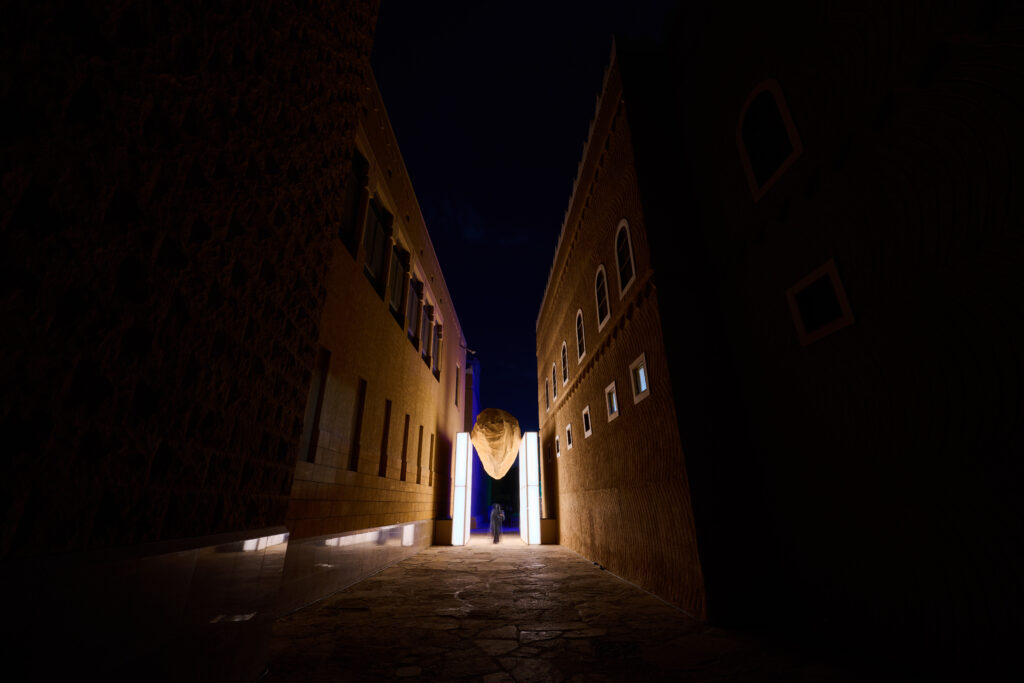
As visitors stepped into the passage, the illuminated walls pulsed in response, transforming the installation from a sculptural object into a dynamic experience. “Interactivity brought the viewer into the narrative,” Aljoaib noted. “Each person’s passage slightly shifted the pulse of the light, turning the installation into something that acknowledged the individual within the collective story.”
This responsiveness created a living, temporal architecture shaped by human presence. Movement, curiosity, and approach subtly altered the atmosphere. “It reminded me that transformation is shaped by human proximity — by curiosity, by presence, by the way we inhabit space,” she reflected.
Through this interactivity, the installation became a meditation on how individuals participate in — and influence — the nation’s unfolding cultural transformation.
A Contemporary Saudi Aesthetic Rooted in Clarity
Between Light and Stone expanded on Aljoaib’s broader design language, one defined by material depth, refined minimalism, and cultural resonance. Since founding her studio in 2015, she had cultivated a practice that bridged interiors, furniture, and sculptural work, unified by precision and emotional grounding.
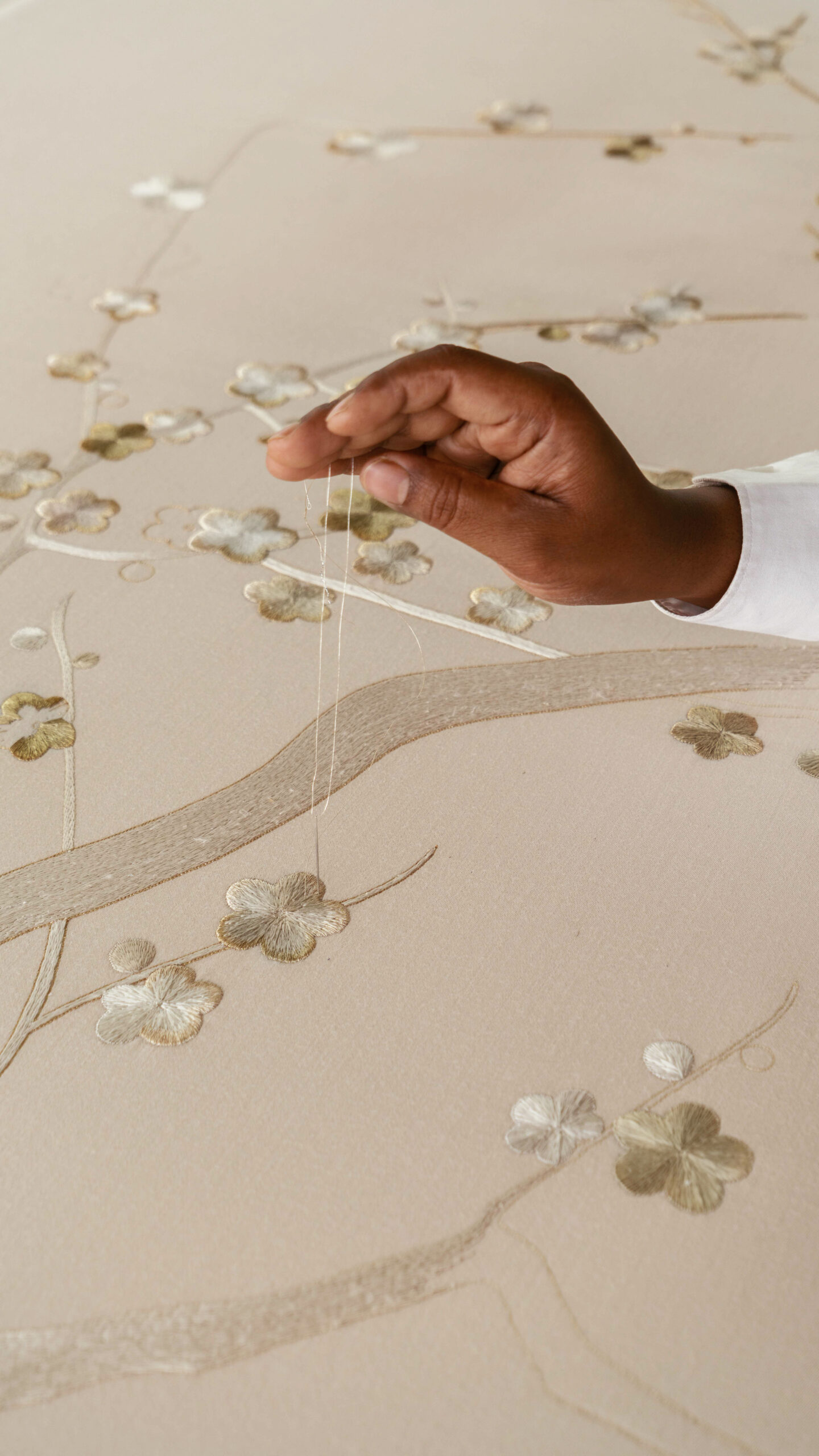
“Whether I design interiors, furniture, or installations, the story always begins with material and emotion,” she explained. “Scale only changes the choreography, not the essence.”
“For me, the defining gesture of contemporary Saudi design is clarity rooted in heritage — not replication, but reinterpretation,” she said. This ethos resonated throughout the installation: stone conveyed memory and ancestry, while light represented momentum and aspiration.
A Metaphor for Riyadh, and for the Kingdom’s Cultural Momentum
In its historic setting, Between Light and Stone became a metaphor for Riyadh itself — a city balancing continuity with an ambitious, forward-looking vision. The raw stone echoed the endurance of place; the luminous walls captured the city’s rapid cultural acceleration.
At a moment when Noor Riyadh reaffirmed its position as the world’s largest light art festival, Aljoaib’s installation stood out for its introspective clarity. It was a reminder that transformation gains depth when it remains connected to what endures.
“Stone, in particular, carried this duality,” she reflected. “It is ancient, yet capable of expressing modern precision. Light allowed me to reveal its presence without overpowering it.”
The installation offered a grounded, poetic reading of Saudi Arabia’s evolving creative identity — confident, intentional, and deeply tied to notions of place, memory, and meaning.
In the blink of an eye, Between Light and Stone reminded visitors that the future becomes richer not when it accelerates, but when it listens to what endures.