Words by Allegra Salvadori
In the luminous quiet of his Beirut studio, brass letters glint under the light — not as words to be read, but as shapes to be felt. For Lebanese designer and artist Iyad Naja, creation begins in that moment where emotion becomes matter, and heritage finds new expression through contemporary form. “What drew me into this world,” he says, “was the joy of seeing something that lives in your mind take physical form. There is a spark in that process, an energy that feeds you and keeps you creating.”
Naja’s path into design was neither linear nor conventional. He began in advertising — a world of discipline, deadlines, and strategy — before finding his true medium in what he calls functional art. The shift was less a departure than an evolution. “Advertising strengthened me in a way that artists are not always expected to be,” he recalls. “It taught me how to think conceptually while making ideas tangible.” Years later, with a Master’s in Islamic Art and Architecture, Naja has found the intersection where structure meets soul — a language where precision and poetry coexist.
Rooted deeply in his Lebanese and Arabic identity, Naja’s work is both a return and a reimagining. He describes himself as a “third-culture child,” shaped by the distance between belonging and longing. “That distance gave me a deep appreciation for my roots,” he explains. “By translating cultural memories into design, I give them form and relevance in today’s world.” His creations — sculptural doors, brass wall art, and calligraphic surfaces — carry the cadence of heritage without nostalgia. They are bridges between what is remembered and what is redefined.
At the heart of his practice lies Arabic calligraphy — not as text, but as living form. “It’s far more than a visual motif; it is a living language that continues to evolve,” he says. “When calligraphy enters the realm of art and design, it is no longer meant to be read; it is meant to be felt.” His letters curve and converge into rhythmic structures that guide the viewer’s gaze, sometimes readable, sometimes abstract. In his words: “The words are not the dominant element; they serve the form. The letters weave together, creating movement and rhythm, and sometimes they guide you instead of being guided.”
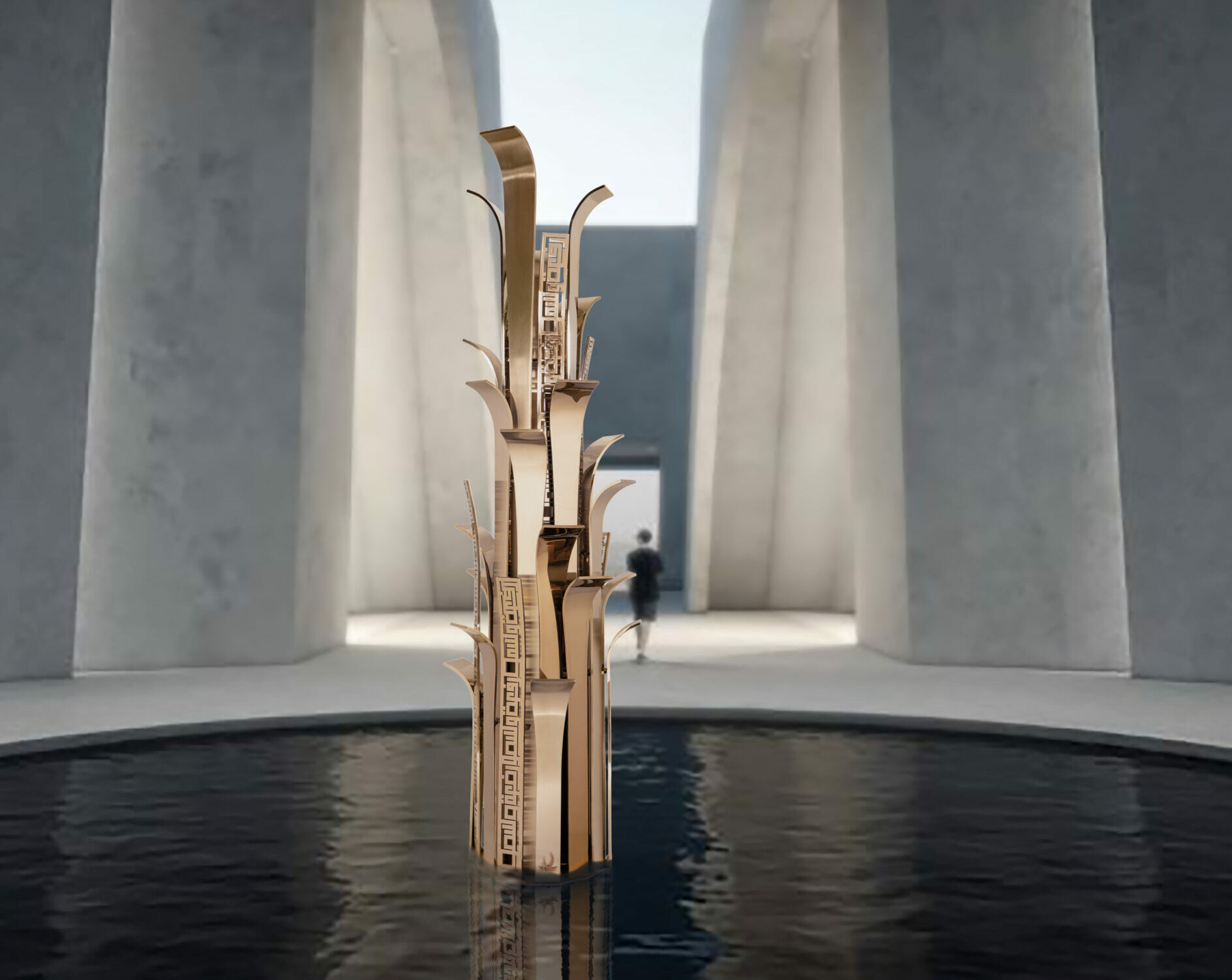
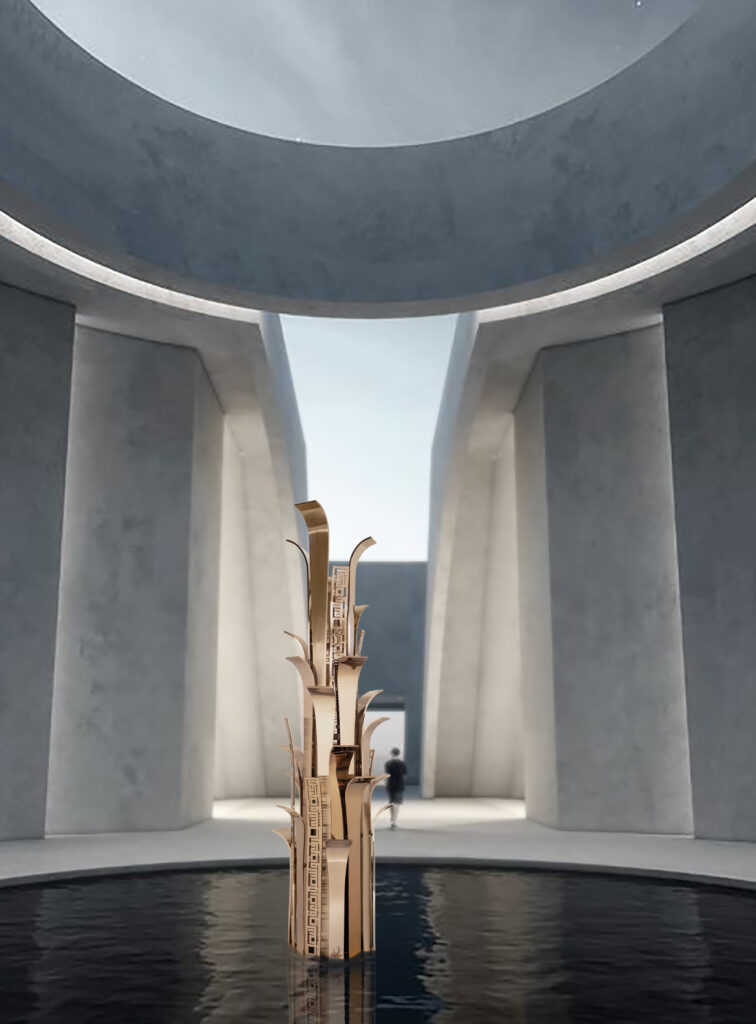
One of the most striking embodiments of this philosophy is his two-meter-tall fountain, crafted from gold-plated metal and inspired by the silhouette of a traditional water source reimagined as contemporary sculpture. Its alternating matte and glossy finishes create a subtle play of light that accentuates the Arabic calligraphy integrated into the surface. Featuring phrases of praise and Bismillah in Kufic script, the piece merges cultural memory with modern craftsmanship, achieving a balance of elegance and spiritual depth.
Despite the poetic sensibility, Naja’s practice is firmly contemporary. His works are born not from chisels and mallets, but from cutting-edge technology. “Traditional craft techniques play no direct role in my work today,” he admits. “What defines my approach is the way materials are selected and manipulated using advanced fabrication methods. The challenge is to carry the spirit of heritage while fully belonging to today’s world.”
That modernity does not diminish emotion; it amplifies it. Each piece, whether a chandelier or a sculptural panel, exists at the meeting point between presence and contemplation. “My pieces are designed to be both contemplated and lived with,” he explains. “They are aesthetic objects that invite reflection, often becoming conversation pieces within a space.”
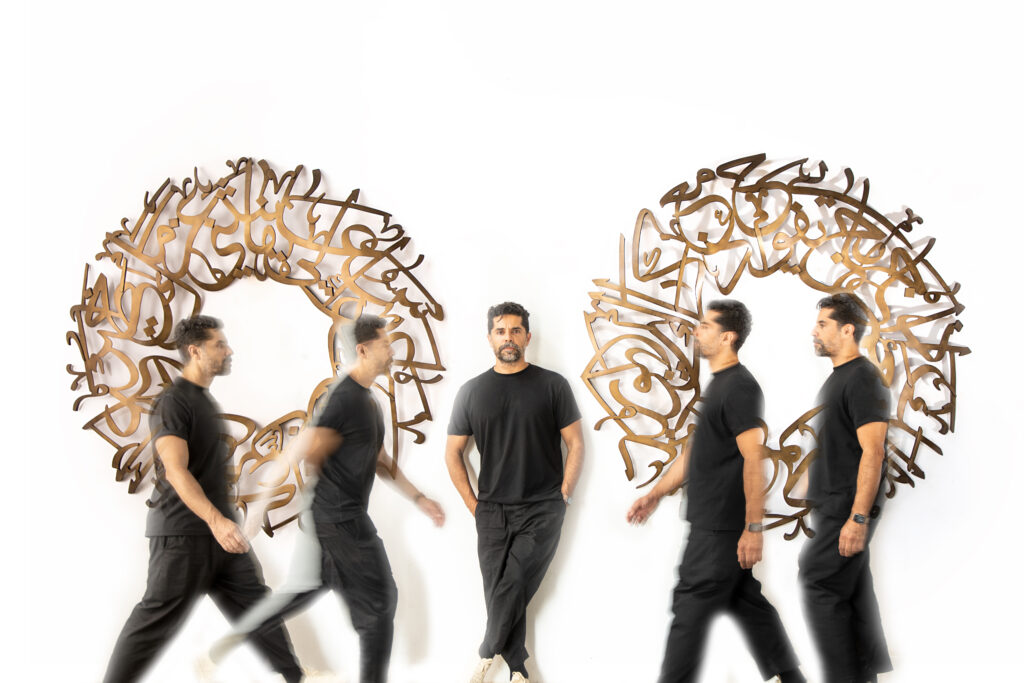
This dual presence is embodied in a pair of sculptural twin structures carved from solid brass, where intertwined Thuluth calligraphy becomes both ornament and architecture. Their concave form creates a sense of movement and depth, while the flowing script evokes poetry and timeless praise. Each curve and connection between the letters reflects a dialogue between form and meaning — a celebration of language as structure, gesture, and living memory.
Ultimately, Naja sees his creations as living stories — dialogues between material and memory. “Every piece tells a story of transformation,” he reflects. “I want people to feel a balance between power and calm, between what’s rooted in heritage and what belongs to the present.” Looking ahead, his vision expands beyond objects to environments. He dreams of immersive, nature-integrated installations — “from desert dunes to the edge of the sea” — where design becomes an experience, and heritage an atmosphere.
Iyad Naja’s creations whisper what design can sometimes forget: that beauty is not only what we see, but what we remember.